Best Hanging Bird Feeders in 2026 — 8 Picks, and the Hanging Spot That Decides If They Work
A hanging bird feeder is the first feeder almost everyone buys, and the one most often blamed when things go wrong. Seed goes mouldy, squirrels empty it in an afternoon, or nothing shows up for weeks — and the usual conclusion is that the feeder was cheap.
It usually isn't the feeder. It's the hook it's hanging from.
Below are eight hanging feeders from our range, ranked by what they actually do well, with real prices and honest notes about what each one can't do. But read the next section first — it will change which feeder you buy, and it costs nothing.
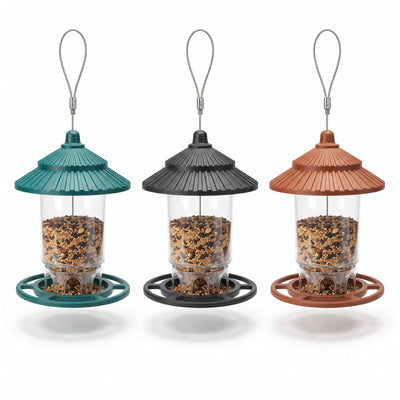
Six Ports, a 360° Perch Ring and a Steel Cable for $41

BIRDLOVER 6-Port Gazebo Hanging Bird Feeder with 360° Perch Ring
6 seed ports · 360° perching ring · slide-lift rain roof · clear seed hopper · chew-proof steel cable · Garden Green, Charcoal Black or Rustic Brown
The steel cable can't be chewed, but no hanging feeder is squirrel-proof on its own — read the 5-7-9 rule just below before you choose where it hangs.
Want a heavier-duty gazebo? The Amish Handcrafted Red Cedar & Recycled Plastic Gazebo Bird Feeder ($58) is the cedar version of the idea: Amish-made in the USA, 5 lb by the maker's figure, with a recycled-plastic roof, a polycarbonate tube that holds 2.15 quarts and a coated steel hanging cable.
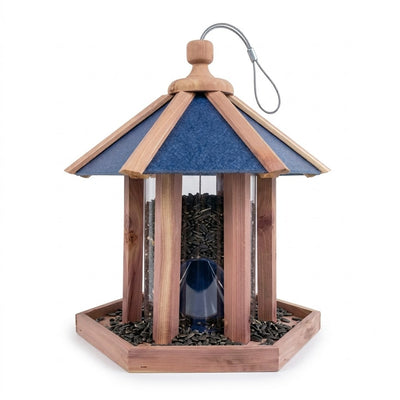
A Red Cedar Gazebo on a Steel Cable — $58

BIRDLOVER Amish Handcrafted Red Cedar & Recycled Plastic Gazebo Bird Feeder ($58 · 2-Pack $99)
Amish-made in the USA · red cedar body, recycled-plastic Admiral Blue roof · holds 2.15 qt of seed · six-sided platform, perforated base · coated steel hanging cable
It weighs 5 lb before seed, so hang it from a sturdy hook or bracket, and use the 5-7-9 rule below for the spot. 2-Pack $99.
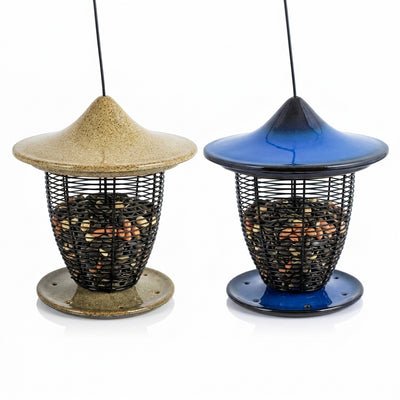
Want the pagoda shape in ceramic? The Handcrafted Glazed Ceramic & Steel Wire Pagoda Hanging Bird Feeder ($64) hangs a steel wire basket under a glazed stoneware roof, with a 10-inch ceramic rim below it. Clinging birds feed all the way round the wire, cardinals and jays use the rim, and the roof slides up the cable for filling. Like the Amish gazebo it is heavy, about 5 lb, so give it a sturdy hook.
A Glazed Ceramic Pagoda on a Steel Cable — $64

BIRDLOVER Handcrafted Glazed Ceramic & Steel Wire Pagoda Hanging Bird Feeder ($64 · 2-Pack $109)
11 in tall · about 5 lb · glazed stoneware roof & base · powder-coated steel wire basket · drainage holes in the base · Sandy Granite or Cobalt Blue
Squirrels can still reach seed through the wire, so the 5-7-9 rule below still applies. 2-Pack $109.
Your Feeder Isn't the Problem — Your Hanging Spot Is
A hanging feeder has one variable that a pole-mounted feeder doesn't: you get to choose where it hangs, and almost everyone chooses badly. The default choice — a tree branch — is the single worst option available in a typical garden.
There are three numbers worth committing to memory. Squirrel-proofing a hanging feeder is geometry, not gadgetry.
- 5 feet off the ground. A grey squirrel can jump roughly five feet vertically from a standing start. Below that, the feeder is simply a snack at head height.
- 7 feet from the nearest launch pad. Fence rail, shed roof, wall top, tree trunk, garden bench, the water butt, the barbecue you forgot about. A squirrel's horizontal leap is in the seven-to-ten-foot range, and it will find the launch pad you didn't think of.
- 9 feet below any overhanging branch. This is the one people miss. Squirrels drop down onto feeders far more often than they climb up to them, and they will happily fall nine feet onto a swinging feeder and hang on.
Now look at a tree branch again. It fails all three at once: it's an overhang, the trunk is a launch pad, and the branch itself is a walkway. That is the whole reason "just hang it from a tree" so reliably disappoints. It has nothing to do with the feeder.
If your garden has no spot that satisfies all three — most small gardens don't — the honest answer is that you need a hanging point you control rather than one the garden gave you. A shepherd's crook or a feeding pole with a baffle puts the feeder wherever you want it, at the height you want, with a physical barrier below. That's what our bird feeding stations are for, and it's a better first purchase than a more expensive feeder.
On a patio, balcony or courtyard with no room for a pole, a wall bracket is the other hanging point you control. Be clear about what it is: the wall is a launch pad, so a bracket fails the 7-foot test by design and suits spots where squirrels aren't the problem. Ours, the 3-in-1 Wall-Mounted Metal Bird Bath & Feeder, puts a hook under an 11-inch arm and a shallow basin on top, so the same fixing gives you a bird bath too.
Wall Bracket, Bird Bath and Tray in One — $48

BIRDLOVER 3-in-1 Wall-Mounted Metal Bird Bath & Feeder ($48 · 2-Pack $82)
about 10.5 in steel basin, about 1 in deep · 11 in wall arm · hanging hook underneath · matte black powder coat
Hang a tube, teardrop or suet feeder from the hook and keep water in the basin above. Change the water daily, since birds waiting for the feeder perch on the rim.
The window distance that prevents strikes
Two distances are safe, and the gap between them is not. Hang the feeder either closer than 3 feet to the glass, or further than 30 feet away.
The logic is speed. Within three feet, a bird startled off the feeder cannot build up enough momentum to injure itself on the reflection. Beyond thirty feet, the reflected sky and greenery no longer read as a continuous flight path worth accelerating into. The dangerous zone is the comfortable-looking middle — eight or ten feet from the kitchen window, which is exactly where most people hang their first feeder.
And one more: keep cover close, but not too close
Songbirds won't settle at a feeder marooned in open lawn; they want a bolt-hole. About ten to twelve feet from a shrub or hedge is the working compromise — near enough that a bird can reach cover in one flight, far enough that a cat can't spring from inside it. Closer than that and you've built an ambush point.
Get these three things right and a $27 feeder outperforms a $70 one hung badly. That's not a figure of speech — it's the most common reason people replace a feeder that was never at fault.
The 8 Best Hanging Bird Feeders — Compared
Prices are current at the time of writing (September 2026). Capacities are listed only where the manufacturer states them; where a figure isn't given, we've left it blank rather than guess.
| Feeder | Price | Material | Stated capacity | Feeding style | Best for |
|---|---|---|---|---|---|
| Handcrafted Cedar Hanging Feeder | $62.00 | Natural cedar | 3 lb | Hopper | Best overall |
| Large Capacity Hanging Feeder | from $20.55 | Plastic, clear body | 2.6 lb | Ports + shelf | Best value |
| Gold Umbrella Bird Feeder | $52.41 | Iron | — | Open tray + canopy | Cardinals & larger birds |
| Vintage Umbrella Hanging Feeder | $29.00 | Metal | — | Open tray + canopy | Rain protection on a budget |
| Owl Hanging Feeder | $27.00 | Metal mesh | — | Mesh / clinging | Clinging birds |
| Hanging Feeder, Weather Resistant | $52.00 | Weather-resistant outdoor | 3.2 lb | Enclosed | Longest between refills |
| Rustic Wooden Hexagonal Feeder | $52.00 | Natural wood | — | Hopper, six-sided | Cottage gardens |
| Glass Hanging Feeder, Upcycled | $42.00 | Upcycled glass | — | Open dish | Garden art |
For Balconies and Small Gardens: A Pod Sized for Small Songbirds

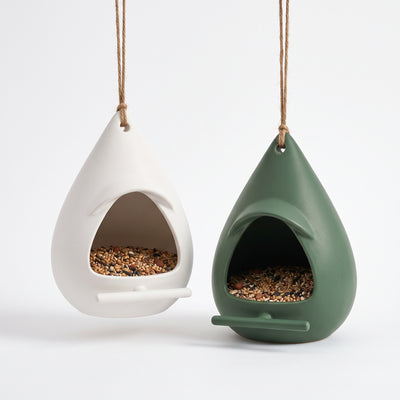
BIRDLOVER Nordic Teardrop Hanging Bird Feeder with Rain Hood & Perch
5.24" small-bird pod · overhanging rain hood · front perch bar · BPA-free polymer · jute hanging cord · Matte White or Garden Green
A compact pod for finches and chickadees, not a bulk hopper — top it up little and often. Set of 2 (one of each colour) for $69.
1. Handcrafted Cedar Hanging Bird Feeder — Best Overall
$62.00 · 3 lb capacity · natural cedar · hanging cord included
Cedar earns its place here on material properties rather than looks. It resists rot, insects and moisture without chemical treatment, which matters more for a feeder than for most garden timber — anything you apply to preserve the wood is sitting inches from food that birds eat. Untreated cedar solves that problem by not needing solving.
The 3 lb capacity is at the useful end for a hanging hopper. In midwinter, when a busy garden can strip a small feeder daily, a feeder you top up twice a week is one that stays on the birds' feeding route. Left outdoors, cedar greys to a silver patina — that's the wood weathering as intended, not failing.
Trade-off: like every hopper on this list, it isn't squirrel-proof. It's the feeder to buy once the hanging spot is sorted.
View the Handcrafted Cedar Hanging Bird Feeder →
2. Large Capacity Hanging Bird Feeder — Best Value
From $20.55 · 2.6 lb capacity · twist-lock lid · blue, grey or brown · 6.5 × 6.5 × 5.3 in
The most feeder-per-dollar on this list, and the design details are genuinely thought through rather than decorative. The lid twists shut like a jar lid, so a squirrel leaning on the rim is pressing down on a locked collar instead of levering up a loose top — that won't stop a determined squirrel eating from the shelf, but it does stop the usual raid, which is flipping the lid and emptying the lot.
The body is transparent, which sounds cosmetic and isn't. Being able to see the seed level from indoors is the single thing that makes people actually keep a feeder topped up, rather than discovering it's been empty for five days. The hexagonal base flares wider than the roof line above it, so rain runs off the eaves and lands outside the feeding ring rather than into the seed.
Trade-off: plastic rather than metal or wood, and 2.6 lb is smaller than the cedar. At this price that's a fair exchange.
View the Large Capacity Hanging Bird Feeder →
Prefer Metal Where It Counts? Six Metal Ports for $36

BIRDLOVER Classic 6-Port Metal Hanging Tube Bird Feeder ($36 Single / $62 2-Pack)
6 metal ports with perches · metal domed lid & base · clear polycarbonate tube · 16.5 in tall · Forest Green or Antique Red Bronze
Metal ports, lid and base on a clear polycarbonate tube. Like every hanging feeder, it isn't squirrel-proof on its own, so follow the 5-7-9 rule above.
3. Gold Umbrella Bird Feeder — Best for Cardinals and Larger Birds
$52.41 · iron · 14.6 in canopy · open tray
Tube feeders with small ports quietly exclude most of the birds people actually want. Cardinals, jays, doves and mockingbirds need somewhere to stand, and an open tray gives them that. This one pairs the tray with a 14.6-inch iron canopy that is wider than the tray beneath it, so water runs off the edge and falls clear instead of soaking into the food — the simplest possible answer to the oldest problem in bird feeding, with no drainage holes to unblock.
The canopy does a second job worth knowing about: it shades the tray. Oily seed like sunflower turns rancid fastest in direct summer sun, and shade buys you time.
Because nothing has to fit through a hole, you can put anything in it — mealworms, fruit, a broken-up fat ball — which brings in birds a seed feeder never gets.
Trade-off: an open tray is an open invitation to squirrels, and birds will scatter some seed while sorting it. Fill it shallow and often rather than deep and rarely.
View the Gold Umbrella Bird Feeder →
4. Vintage Umbrella Hanging Bird Feeder — Best Rain Protection Under $30
$29.00 · all-metal · umbrella canopy · pre-attached hanging chain
The same canopy-over-tray principle as the gold umbrella above, in a smaller, rustic-finished, all-metal package at roughly half the price. No plastic anywhere is worth something on a feeder that lives permanently outdoors — there's nothing to go brittle in UV and nothing for a squirrel to chew through.
It arrives with the hanging chain already attached, which is a small thing until you've assembled a feeder in February.
Trade-off: a smaller tray than the gold umbrella, so it needs refilling more often in a busy garden.
View the Vintage Umbrella Hanging Bird Feeder →
5. Owl Hanging Feeder — Best for Clinging Birds
$27.00 · metal mesh
Mesh feeders do something enclosed hoppers can't: they let birds cling to the outside and feed from any point on the surface. That suits chickadees, titmice, nuthatches and finches, which are natural clingers and will happily hang upside down to eat — and it gently excludes the larger, pushier birds that can't grip mesh.
Mesh also drains. Rain passes straight through rather than pooling, which is the failure mode that ruins seed in flat-bottomed feeders. Fill it with sunflower hearts or peanuts rather than a fine mixed seed, which will simply fall through.
If it is specifically finches you are after, a dedicated nyjer tube or fine-mesh feeder does this job better — see our guide to the best finch feeders. If you would rather feed finches sunflower hearts, our $34 Classic 2-Port Hanging Tube Finch Feeder is the simplest way to start.
Trade-off: the owl shape is firmly decorative — if you want something that disappears into the garden, this isn't it.
6. Hanging Bird Feeder, Weather Resistant 3.2 lb — Longest Between Refills
$52.00 · 3.2 lb capacity · weather-resistant construction
The largest stated capacity in our hanging range. If your garden empties a feeder faster than you want to refill it — or you're away midweek and want the feeding route to survive your absence — capacity is the spec that matters, and 3.2 lb is a meaningful step up from the 2.6 lb and 3 lb feeders above.
A note on the name: this feeder is sold as squirrel-proof, and its enclosed design does make casual raiding harder than an open tray. We'd rather be straight with you than repeat the label: no hanging feeder is reliably squirrel-proof on its own. A squirrel that can reach it will work on it. If squirrels are your actual problem, the fix is the hanging position and a baffle — see the 5-7-9 rule above — or a purpose-built mechanism from our squirrel proof bird feeders.
View the Weather Resistant 3.2 lb Hanging Feeder →
Want a hanging feeder built to keep grey squirrels off the seed? Put a cage around it. Our Squirrel-Proof Metal Mesh Caged Hanging Tube Bird Feeder ($38) surrounds a 4-port tube with a powder-coated steel cage and clips its lid shut, so grey squirrels, jays and grackles stay outside while chickadees and finches feed. Red squirrels and chipmunks can still squeeze through most cages, so the hanging spot above still matters.
7. Rustic Wooden Hanging Bird Feeder, Hexagonal — Best for Cottage Gardens
$52.00 · natural wood · hexagonal · hanging fixture included
The six-sided design isn't only aesthetic. A hexagonal feeding surface gives birds multiple approach angles, so arriving birds shuffle round the perimeter rather than displacing whoever got there first — you end up watching three or four birds at once instead of a queue and a squabble.
Natural wood, no plastic or synthetic materials, and it weathers into the garden rather than sitting on top of it. Works with all standard seed mixes.
Trade-off: untreated wood in a wet climate wants a sheltered hanging point — under an eave or a dense branch — to get the most years out of it.
View the Rustic Wooden Hexagonal Feeder →
8. Glass Hanging Bird Feeder, Upcycled — Best as Garden Art
$42.00 · upcycled vintage glass with decorative gems
Handcrafted from reclaimed glass, so no two are identical — the piece you receive is genuinely unique, and the decorative gems throw colour around when the sun catches them. If the feeder is going somewhere you look at every day, that matters as much as capacity does.
It's also the most straightforwardly sustainable feeder here: existing material given a second life rather than new material manufactured. If that's the deciding factor for you, our eco friendly bird feeders collection goes further in the same direction.
Trade-off: an open glass dish holds less than a hopper and needs emptying after heavy rain. Treat it as a beautiful supplementary feeder rather than your main one.
View the Glass Hanging Bird Feeder →
How to Choose Between Them
Strip away the styling and there are really only three decisions:
- Open tray or enclosed hopper? Open trays feed everything, including cardinals, jays and doves, and let you offer fruit and mealworms — but they waste more seed and invite squirrels. Enclosed hoppers keep seed drier and last longer between fills, but quietly turn away the bigger birds.
- How often do you want to refill? Capacity is the least glamorous spec and the one that decides whether you keep feeding in January. Anything at 2.6 lb or above will hold a busy garden for several days.
- Where will it actually hang? Answer this before choosing a feeder, not after. A wooden feeder wants shelter; a metal one tolerates open weather; and if there's no spot that clears the 5-7-9 numbers, budget for a pole before you budget for a nicer feeder.
Every feeder on this page ships free.
Frequently Asked Questions
Where is the best place to hang a bird feeder?
At least 5 feet off the ground, at least 7 feet horizontally from anything a squirrel could launch from, and at least 9 feet below any overhanging branch. Keep it about 10 to 12 feet from a shrub or hedge so birds have cover to escape to, and either closer than 3 feet to a window or more than 30 feet away to prevent collisions. A tree branch fails most of these at once, which is why it's the most common mistake.
How high should a hanging bird feeder be?
Five feet off the ground is the working minimum, because that's roughly how high a squirrel can jump from a standing start. Five to six feet also puts the feeder at a comfortable height for refilling and cleaning, and keeps it above the reach of most cats.
Are hanging bird feeders squirrel-proof?
Not on their own, and you should be sceptical of any hanging feeder sold as though it were. Position does most of the work: a feeder that clears 5 feet up, 7 feet across and 9 feet below a branch is genuinely hard for a squirrel to reach. Add a baffle on the hanging line or use a pole with a baffle and you've solved it properly. A feeder with a locking lid helps with the specific raid where a squirrel flips the top off, but it won't stop one that's already standing on the tray.
What seed should I put in a hanging feeder?
Black oil sunflower seed or sunflower hearts attract the widest range of garden birds and leave the least uneaten filler on the ground. Peanuts suit mesh feeders and clinging birds. Cheap mixes padded with wheat and milo tend to get scattered rather than eaten, which looks like a busy feeder but is mostly waste. Match the food to the feeder: fine mixed seed falls straight through mesh, and open trays will take mealworms and fruit that no port feeder can offer.
How often should I clean a hanging bird feeder?
Every couple of weeks in warm weather, and monthly in cold. Take it apart, wash in hot soapy water, rinse and — this is the step people skip — dry it completely before refilling, because damp seed spoils fast and mouldy feeders spread disease between birds. Open trays and dishes need it more often than enclosed hoppers, since everything in them is exposed to rain.
Why are no birds using my new feeder?
Usually time and position. Birds find feeders by watching other birds, so a brand-new feeder in a garden with no feeding history can take two to six weeks to be discovered. Beyond that, check the two things most often wrong: the feeder is marooned in open space with no cover within about ten feet, or it's in the middle of an active route for cats. Moving a feeder a few metres does more than replacing it.
Will a hanging feeder work on a balcony or small patio?
Yes, and it's often the only feeder type that will. A bracket hook on a wall or railing gives you a hanging point where there's no room for a pole. Choose a smaller, enclosed feeder rather than an open tray — like our $39 Nordic Teardrop Hanging Feeder, with a rain hood and front perch — because spillage matters far more on a balcony than in a garden — and hang it clear of the railing itself so it isn't reachable from the top rail.
Metal, wood or plastic — which lasts longest outdoors?
Metal is the most weather-tolerant: nothing to go brittle in UV and nothing for a squirrel to chew, though a painted finish will soften over the seasons. Untreated cedar and other naturally durable woods handle rain and insects without chemical treatment and grey attractively as they age, but last longest under some shelter. Plastic is the lightest and cheapest and is fine for a few seasons, especially where it's sheltered from direct sun.
Shop the Full Range
Browse every one of these picks — in this order — in our hanging bird feeders collection. If squirrels are the reason you're here, start with bird feeding stations instead; if you want the wider picture across every feeder type, see our guide to the best bird feeders. For goldfinches and siskins specifically, our guide to the best finch feeders covers nyjer tubes and caged screen feeders. And if you would rather hang a complete setup in one go, the Tall Sterling Heavy-Duty Triple Bird Feeder Set pairs a seed tube, peanut mesh and suet ball feeder in a single heavy-duty 3-pack.
Prices listed are current at the time of writing and may change. Free shipping applies to all orders.