Best Finch Feeders in 2026 — 8 Picks, and the Seed Problem That Decides If Finches Show Up
Share
A finch feeder is the one feeder people buy for a specific bird. Nobody buys a nyjer tube hoping for pigeons — they buy it because they saw a goldfinch once and want it back.
Which is why the failure is so frustrating. The feeder goes up, the seed goes in, and for weeks nothing happens. The usual conclusion is that the feeder was the wrong one.
Usually it isn't the feeder. It's the seed inside it.
Below are eight finch feeders from our range with real prices and honest notes on what each one can't do. But read the next section first — it costs nothing and it will change both which feeder you buy and how big a bag of seed you buy with it.
First, Solve the Stale Nyjer Problem
Nyjer is not like other birdseed, and almost every disappointing finch feeder comes down to that difference being missed.
Start with what it actually is. Nyjer isn't thistle, despite being sold as "thistle seed" for decades — it's the seed of an African daisy, Guizotia abyssinica, grown mostly in Ethiopia and India and imported. Because it could sprout as a weed, imported nyjer is heat-sterilised before it reaches a shop shelf. That process kills the germ, and it also starts the clock on the seed's shelf life.
Then there's the oil. Roughly a third of a nyjer seed's weight is oil, which is exactly why finches want it and exactly why it doesn't keep. Oil goes rancid. Rancid nyjer looks close enough to fresh nyjer that a person can't tell at a glance — and a goldfinch can tell instantly, and will simply not land.
So an untouched finch feeder is far more often a feeder full of dead seed than a badly designed feeder. Four habits fix it permanently.
- Learn the pinch test. Fresh nyjer is jet black and glossy, and if you pinch a few seeds hard between finger and thumb they leave a faint oily mark. Seed that has gone over looks dull, greyish-brown and dusty, feels brittle, and leaves nothing behind. This takes three seconds and is the single most useful thing in this article.
- Buy the small bag. Nyjer is expensive per pound, so the big sack looks like the sensible purchase. It isn't — you are buying more time for oil to spoil. Buy what your garden will get through in a few months, keep it sealed in a cool dark place, and never store it in the shed over a warm summer.
- Match the feeder to the flock, not to your ambition. A three-quart tube in a garden with four goldfinches will go stale long before it goes empty. If you're starting out, buy the smaller feeder — or fill a large one a third full until you know what your garden's traffic actually is. Turnover keeps seed fresh far more reliably than any feature on the box.
- Empty it before you refill it — never top up. Old seed sinks. Top up over it and the oldest, dampest, most compacted seed stays permanently at the bottom of the tube, which is exactly where the lowest ports are. Those bottom ports clog first, the seed there cakes, and the feeder slowly becomes a sealed tube with a few working holes at the top.
The other half of the problem is water
Nyjer absorbs moisture readily and then clumps. A tube that has taken a week of rain develops a solid plug in the bottom inch, and no amount of shaking clears it. This is why two unglamorous features matter more on a finch feeder than on any other kind: an internal baffle at the base, which slopes the last of the seed toward the ports instead of letting it sit in a flat pool, and drainage holes in the tray or base so rain leaves rather than collects. Several feeders below have both, and it's worth more than an extra port or two.
One last thing, because it saves people from replacing a feeder that was fine: finches genuinely are slow to find new feeders. A few weeks of nothing in a garden with no feeding history is normal, not a verdict. But if it has been that long and the seed is fresh and the feeder is near cover, the problem is the position rather than the purchase — see the placement notes further down.
Nyjer or Sunflower Chips? This Decides Which Feeder You Buy
There are two ways to feed finches, and they need different feeders. Choosing the seed first makes the feeder choice obvious.
The nyjer route. Nyjer is tiny, so it needs either narrow slit ports or a very fine mesh — put it in an ordinary seed tube and most of it pours onto the grass. The payoff is exclusivity: house sparrows, grackles, starlings and jays mostly leave nyjer alone, so a thistle tube stays a finch feeder without you doing anything else. The cost is price per pound and the shelf life problem above.
The sunflower-chip route. Hulled sunflower hearts and chips are cheaper, keep better, and finches love them — but so does every other bird in the garden, and a plain tube of sunflower hearts will be occupied by house sparrows within days. The fix is a cage: a wire grid around the tube that small birds pass through and larger ones don't. A caged feeder full of sunflower chips is often the cheaper way to run a finch feeder all year.
Two feeders below do both at once, which is the sensible answer if you're not sure yet.
The 8 Best Finch Feeders — Compared
Prices are current at the time of writing (September 2026). Capacities and dimensions are the manufacturers' stated figures.
| Feeder | Price | Seed | Stated capacity | Feeding style | Best for |
|---|---|---|---|---|---|
| Thistle Tube, Large, Antique Brass | $43.23 | Nyjer | 1.25 qt · 10 ports | Ported tube, perches | Best overall |
| Magnum Thistle Seed Feeder | $26.78 | Nyjer | 3 qt | Fine mesh + tray | Best value, big flocks |
| Cling and Catch Finch Feeders, Pack of 2 | $42.29 | Nyjer | 1.3 qt each | Mesh, clinging | Two feeding stations |
| Caged Screen Tube Feeder | $35.67 | Sunflower / peanut | 0.75 qt | Caged mesh tube | Keeping bigger birds out |
| Audubon Squirrel-Resistant Caged Tube | $64.42 | Sunflower / mixed | 0.85 qt · 4 ports | Caged ported tube | Squirrels and grackles |
| Combination Thistle and Seed, Large | $54.13 | Both | 5 qt total · 3 ports | Split mesh tube | Feeding both ways at once |
| Seed Tube, Medium, Antique Brass | $39.97 | Sunflower / mixed | 1 qt · 4 ports | Ported tube, perches | Small gardens |
| Copper Colored Mixed Seed Mesh | $40.35 | Sunflower / mixed | 2.75 qt · 4 ports | Mesh + perch tray | Clingers and perchers together |
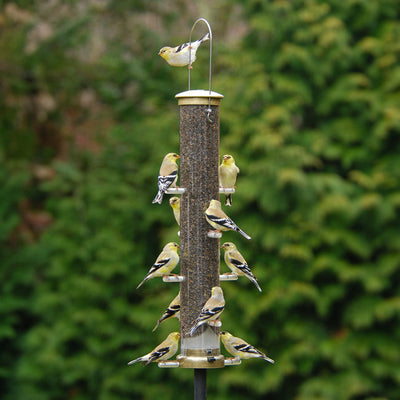
1. Thistle Tube Wild Bird Feeder, Large, Antique Brass — Best Overall
$43.23 · 1.25 qt · 10 ports · 3.375 in dia. × 19.25 in H · made in the USA · lifetime guarantee
Ten ports on a 1.25-quart tube is the ratio that makes this the pick of the range. Goldfinches and siskins feed in flocks and squabble over access, so port count decides how many birds your garden actually holds at once — while the modest capacity behind those ports means the seed turns over in days rather than weeks. That combination is the whole freshness argument built into a single feeder.
The details are the right ones for nyjer specifically. An internal baffle at the base directs seed to the two bottom ports, so the tube empties properly instead of leaving a stale, compacted heel. The Quick-Clean base detaches by squeezing two tabs, which turns a proper clean-out from a chore into a two-minute job — and with an oil-rich seed, how easy a feeder is to empty is a feature, not a convenience. The die-cast cap slides up the hanger for filling, and the base carries two extra perches beyond the ten ports.
Hang it from the fitted loop, or pole-mount it with a 3/4-inch threaded adapter (not included). The manufacturer's own listed visitors are chickadees, finches, goldfinches, redpolls and siskins — a genuinely finch-specific guest list.
Trade-off: nyjer only. Fill it with anything else and it pours out.
View the Thistle Tube Wild Bird Feeder →
2. Magnum Thistle Seed Bird Feeder — Best Value, and Best for a Real Flock
$26.78 · 3 qt (4.5 lb) · 1/16 in wire mesh tube · 8.5 in roof · 8.5 in dia. base × 12.5 in H · made in the USA
The cheapest feeder here and, on paper, the largest — which needs the honest caveat first: three quarts of nyjer is a lot of nyjer. In a garden that has not yet built up a finch flock, this feeder will go stale before it goes empty. Fill it a third full to begin with and let the traffic tell you when to fill it properly.
Given the flock to justify it, it's excellent. The tube is 1/16-inch black wire mesh rather than a ported plastic barrel, so birds can cling anywhere on the surface instead of queueing for six holes — which is how finches prefer to feed and why mesh feeders carry so many birds at once. There's also a perch tray at the base, so the birds that want to sit can, and its drainage holes keep the bottom of the seed column dry. An internal baffle empties the feeder fully, and the 8.5-inch roof slides up the hanging chain for cleaning and filling.
Trade-off: the size is the trade-off. Buy it for a busy garden, not a hopeful one.
View the Magnum Thistle Seed Bird Feeder →
3. Cling and Catch Finch Feeders, Pack of 2 — Best for Two Feeding Stations
$42.29 for two · 1.3 qt each · 2.75 in dia. tube × 14 in H · all steel · yellow roof and base
Two feeders for roughly the price of one good one, and with finches that matters more than it sounds. Goldfinches arrive as a group and displace each other constantly; a second feeder eight or ten feet from the first roughly doubles how many birds settle rather than circle. It also gives you somewhere to put fresh seed while the other tube is drying after a clean — which is the practical reason feeders sit empty for a week.
The tube is a mesh designed for clinging birds, so a finch can grip and feed from any point on the surface rather than needing a perch in front of a port. That matters beyond comfort: house sparrows are far less willing to feed while clinging than goldfinches are, so a clinging design quietly tilts the feeder toward the birds you bought it for. A wide steel plate at the base catches the seed that gets dropped, and the overhang keeps rain off the tube. The manufacturer notes that the yellow roof and base can help attract finches — yellow is a long-standing convention on finch feeders.
Trade-off: 1.3 quarts each is modest, which is the right call for nyjer but means more frequent filling in a busy garden.
View the Cling and Catch Finch Feeders →
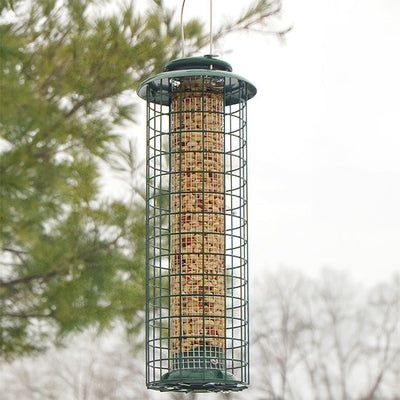
4. Caged Screen Tube Bird Feeder — Best for Keeping Bigger Birds Out
$35.67 · 0.75 qt · 1 in square cage grid · 0.25 in stainless mesh tube · 5.75 in dia. × 16.5 in H
This is the sunflower-chip route done properly. A powder-coated cage with a 1-inch square grid surrounds a stainless steel mesh tube: small songbirds pass through the grid and feed, and anything larger — grackles, starlings, pigeons, squirrels — stops at the bars. Because the inner tube is mesh, birds can either cling to the cage and pull seed toward them or cling to the tube itself, so the feeder holds several birds at once despite its small size.
That small size is deliberate and worth noticing. Three-quarters of a quart sounds stingy until you remember that a feeder which empties in a few days never has the chance to spoil. Combined with a base baffle that empties it completely and drainage holes underneath, it's the most spoil-resistant feeder on this list.
Locks on the roof stop squirrels lifting the lid, and it hangs or pole-mounts on any 1-inch outer-diameter pole.
Trade-off: the cage is the point, but it also means more parts to clean. Fill with sunflower seed or peanut chunks — fine seed falls through mesh.
View the Caged Screen Tube Bird Feeder →
5. Audubon Squirrel-Resistant Caged Tube Bird Feeder — Best When Squirrels Are the Real Problem
$64.42 · 0.85 qt · 4 ports · 1.5 in square cage openings · 9.5 in cage dia. × 15.25 in H
The same caged principle with a ported tube inside instead of mesh, and a slightly more generous 1.5-inch cage opening — the size that lets chickadees, finches and nuthatches through and stops squirrels and grackles at the bars. Birds perch on the cage itself as well as on the four metal perches inside, so it carries more traffic than the small tube suggests.
At 0.85 quarts the reservoir is again deliberately small, turning over quickly. A baffle at the base pushes the last of the seed toward the ports rather than leaving residue behind, and the die-cast cap slides up the hanger for filling and locks against squirrels trying to lever it off.
Trade-off: the most expensive feeder here, and a cage is a compromise by nature — cardinals and jays you might also want are excluded along with the grackles.
View the Audubon Caged Tube Feeder →
6. Combination Thistle and Seed Bird Feeder, Large — Best of Both Routes
$54.13 · 5 qt total (2.5 qt each side) · 3 ports · 6.5 in dia. × 15.5 in H · all metal
If the nyjer-or-sunflower decision above left you undecided, this settles it by refusing to choose. A metal wall splits the feeder in two: one half is a fine diamond mesh holding 2.5 quarts of thistle with three ported perches, the other is a 0.25-inch square mesh holding 2.5 quarts of sunflower seed or peanut splits for clinging birds.
In practice it lets you run an experiment rather than a guess — put both seeds up in the same spot, at the same height, and watch which side the finches actually work. In most gardens one side outperforms the other clearly within a fortnight, and you've learned what to buy from then on.
A raised baffle on the base moves seed to the sides of the reservoir rather than letting residue collect, ports at the base feed the attached tray, and drainage holes there keep it dry under a domed roof.
Trade-off: 5 quarts across two chambers is a lot of standing seed. Run it half full unless the traffic justifies more, and expect the sunflower side to draw a wider crowd than just finches.
View the Combination Thistle and Seed Feeder →
7. Seed Tube Wild Bird Feeder, Medium, Antique Brass — Best for Small Gardens
$39.97 · 1 qt · 4 ports · 3.375 in dia. × 14.75 in H · made in the USA · lifetime guarantee
The same build quality as our top pick in a one-quart, four-port body sized for sunflower kernels and mixed seed rather than nyjer. For a balcony, a courtyard or a garden with a handful of regular visitors, this is the right scale — small enough that seed never sits, with metal-reinforced ports and the same Quick-Clean base that comes apart in seconds.
House finches take sunflower kernels happily, so this is a perfectly good finch feeder on the chip route; just be aware it has no cage, so sparrows and larger birds can use it too. If they take over, the caged feeders above are the upgrade path.
Trade-off: no cage and no exclusivity. It feeds finches among everything else, rather than instead of everything else.
View the Medium Seed Tube Feeder →
8. Copper Colored Mixed Seed Mesh Bird Feeder — Best for Clingers and Perchers Together
$40.35 · 2.75 qt · 4 ports · 5 in dia. mesh tube × 12.25 in H · 9.75 in base with perches · all steel
A wide steel mesh tube that clinging birds can work from any angle, wrapped with four ported perches and finished with a broad base tray carrying wider perches of its own. It's the feeder for a garden where you want the finches and the birds that won't cling — chickadees and nuthatches take the mesh, while heavier perching birds use the tray.
A raised centre section on the base acts as a seed diverter, directing feed to each bottom opening, and small holes in the tray drain it. The stepped copper-coloured roof lifts off for cleaning and refilling, and the all-steel construction has nothing to go brittle in UV or be chewed through.
Trade-off: mesh this size suits sunflower hearts and mixed seed, not nyjer — fine seed will run straight through. And the wide tray invites the larger birds the caged feeders are designed to exclude.
View the Copper Mixed Seed Mesh Feeder →
Where to Put a Finch Feeder
Finches are small, flock-feeding and nervous, which makes placement slightly different from a general feeder.
- Cover within about 10 to 12 feet. Close enough that a bird reaches a shrub in one flight, far enough that a cat can't spring out of it. Finches abandon a feeder marooned in open lawn faster than most garden birds.
- Higher rather than lower. Goldfinches feed comfortably at five to six feet and above; a feeder at waist height gets a fraction of the traffic and is easier for cats to work.
- Either closer than 3 feet to a window, or further than 30 feet away. Inside three feet a startled bird can't build up enough speed to hurt itself on the reflection; past thirty feet the glass no longer reads as a flight path. The comfortable-looking middle distance is the dangerous one.
- Leave it in one place for a few weeks. Moving a feeder resets the discovery clock every time. If it has to move, move it a few feet at a time.
If there's no spot in your garden that satisfies those, a pole solves it rather than a different feeder — that's what our bird feeding stations are for. And if squirrels are the reason you're reading this, the mechanism matters more than the feeder: see our squirrel proof bird feeders.
Every feeder on this page ships free.
Frequently Asked Questions
What is the best feeder for finches?
A narrow tube or fine mesh filled with nyjer, with more ports than capacity. Finches feed in flocks, so the number of birds that can eat at once matters more than how much seed the feeder holds — and a smaller reservoir keeps oil-rich nyjer fresh because it turns over faster. Our top pick, the Aspects Thistle Tube in Large, is a 1.25-quart tube with ten ports, which is that balance in one feeder. If you would rather feed sunflower chips than nyjer, a caged tube is the better choice because it keeps larger birds off.
Is nyjer the same as thistle seed?
No, though it is sold under that name almost everywhere. Nyjer is the seed of an African daisy, Guizotia abyssinica, not a thistle at all. The confusion is harmless except in one respect: because nyjer could sprout as an unwanted plant, imported seed is heat-sterilised before sale, and that sterilised, oil-rich seed has a noticeably shorter useful life than ordinary birdseed.
Why are finches not coming to my nyjer feeder?
In order of likelihood: the seed has gone stale, the feeder is too new, or it is in the wrong place. Stale nyjer is the most common cause by a wide margin and the easiest to check — fresh seed is jet black and glossy and leaves a faint oily mark when pinched hard, while seed that has gone over is dull, greyish, brittle and dry. Beyond that, finches are slow to find new feeders, so a few weeks of nothing in a garden with no feeding history is normal. If the seed is fresh and time has passed, move the feeder nearer cover rather than replacing it.
How long does nyjer seed stay fresh?
Less time than most birdseed, because roughly a third of its weight is oil and oil goes rancid. Buy quantities you will get through in a few months rather than a season's supply, keep the bag sealed in a cool dark place, and never leave it in a hot shed over summer. In the feeder itself, the deciding factor is turnover: seed that is eaten within days never has time to spoil, which is why matching feeder size to your actual flock matters more than buying the largest feeder available.
Should I top up my finch feeder or empty it first?
Empty it first, every time. Old seed sinks to the bottom of a tube, so topping up leaves the oldest and dampest seed permanently sitting over the lowest ports — the ones that clog first. Nyjer also absorbs moisture and cakes into a solid plug in the bottom inch after a wet spell, which no amount of shaking will clear. Feeders with a base baffle and drainage holes resist this, and a removable base makes clearing it out a two-minute job.
How do I stop house sparrows taking over my finch feeder?
Two things work. First, feed nyjer rather than sunflower or mixed seed: sparrows, grackles and starlings largely ignore it, so a thistle tube stays a finch feeder without further effort. Second, choose a design that makes birds cling rather than perch. Goldfinches and siskins will grip a mesh tube and feed from any point on it; sparrows are much less willing to. If you want to feed sunflower chips, a cage with roughly one-inch to one-and-a-half-inch openings lets finches through and holds larger birds outside.
How often should I clean a finch feeder?
More often than a general seed feeder — every week or two in warm weather, monthly in cold. Nyjer's oil leaves a residue that ordinary seed doesn't, damp nyjer cakes and moulds quickly, and finches are among the garden birds most affected by disease spread at crowded feeders. Take the feeder apart, wash in hot soapy water, rinse, and dry it completely before refilling. A feeder with a quick-release base is far more likely to actually get cleaned than one that has to be unscrewed.
What time of year do finches use feeders most?
Autumn and winter are the strongest months in most gardens, as natural seed runs out and flocks build up — which is also when a reliable feeder does the most good. One detail that confuses people: American goldfinches moult out of their bright yellow into a drab olive-brown for winter, so a garden that looks like it has lost its goldfinches has often just stopped recognising them. They also nest unusually late in summer, timed to when thistle and similar seeds set, so a quiet feeder in June is not a failing feeder.
Shop the Full Range
Browse every one of these picks — in this order — in our finch feeders collection. For the wider picture across every feeder type, see our guide to the best bird feeders; if it's autumn and you want the clinging birds that feed alongside finches, our guide to the best suet feeders covers the other half of a winter feeding station.
Prices listed are current at the time of writing and may change. Free shipping applies to all orders.