Winter Roosting Boxes for Birds (2026): How They Keep Chickadees Warm, and Which One to Buy
A chickadee weighs about as much as two quarters, and on a freezing night it has to stay warm until sunrise with nothing but its feathers and whatever shelter it can find. Small birds get through long winter nights by tucking into a cavity out of the wind, often several birds together. A winter roosting box gives them that cavity in your garden, close to your feeders.
This guide explains how a roosting box works, why it is built differently from a nest box, the one measurement that decides which birds can use it, and where to hang it. It ends with the two roosting boxes we sell and how they differ.
Quick answer
For chickadees, pick the Handcrafted Cedar Winter Roosting Box ($48): its 1 1/8-inch entrance lets chickadees in and keeps House Sparrows and starlings out. For a bigger shelter that more kinds of small birds can use, pick the Horizontal Winter Roost by Prime Retreat ($149), which is 22 inches long with two 1.5-inch entrances. Hang either one 5 to 10 feet up, facing away from the winter wind, near the feeders the birds already visit.
What Is a Winter Roosting Box?
A roosting box is a small wooden shelter where birds sleep on cold nights. It is not a place to raise young. It looks like a birdhouse, but one detail is turned upside down: the entrance is low, near the bottom, instead of high up near the roof.
That detail is the whole idea. Warm air rises. In a nest box the hole sits near the roof, so the birds' body heat drifts straight out of it. In a roosting box the hole is low, so the warm air collects in the space above it, where the birds sit on perches inside. A few small birds packed into a snug, draft-free box lose far less heat than one bird alone on an open branch.
Roosting box vs. nest box
| Roosting box | Nest box (birdhouse) | |
|---|---|---|
| Used for | Sleeping through winter nights | Raising young in spring and summer |
| Entrance | Low on the front, so warm air stays in | High on the front, so chicks stay safe below it |
| Inside | Perches, pegs or slats to sit on | An open floor for the nest |
| When to put it up | Autumn, and any time through winter | Late winter, before nesting starts |
You need both if you want birds all year: a roosting box for winter nights and a regular birdhouse for the breeding season.
🔍 First, Check the Entrance Hole: It Decides Who Moves In
Most roosting box guides skip this, and it is the most important number on the box. The size of the entrance decides which birds can get in, and also which birds are kept out.
| Entrance size | Birds that fit | Kept out |
|---|---|---|
| 1 1/8 in | Chickadees, Red-breasted Nuthatches, House Wrens (where they winter in the South) | House Sparrows, starlings, and also titmice, Carolina Wrens and White-breasted Nuthatches |
| 1 1/2 in | Chickadees, titmice, nuthatches, wrens, Downy Woodpeckers and Eastern Bluebirds | Larger birds, but House Sparrows fit, and starlings are right at the edge |
So there is a real trade-off. A small hole gives the tiniest birds a shelter no bully can take over. A bigger hole lets more kinds of birds in, including bluebirds, which often roost together in winter, but it also lets House Sparrows in. Decide which birds you want before you pick a box. If House Sparrows are common where you live and chickadees are the birds you want to help, the small hole is the better choice.
The Two Roosting Boxes We Sell
Prices are current at the time of writing and can change. Free shipping on every order.
1. Handcrafted Cedar Winter Roosting Box for Chickadees — Best for Chickadees
From $48 · 1 1/8-inch low entrance · cedar and pine · about 7.5 in tall · 1-, 2- or 3-pack

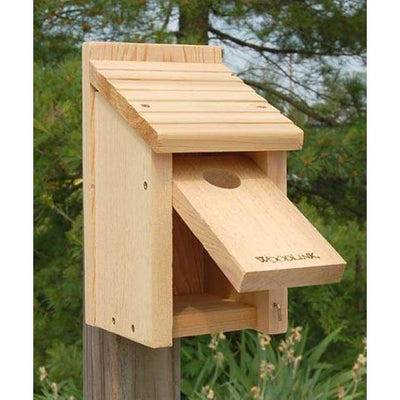
Our own small roosting box, sized for the smallest garden birds. The 1 1/8-inch hole sits low on the front, below the roosting space, so warmth builds up at the top of the box. The inside is about 5.5 × 4 × 3.5 inches with a wooden roosting peg: small enough that a few birds' body heat makes a difference.
- Cedar and pine, finished with a water-based clear sealant rather than paint or stain (per supplier)
- Front panel comes off with four screws, so it is easy to clean out each spring
- Pre-drilled mounting holes, exterior screws included
- Price per box drops in the packs: $48 for one, $84 for two, $119 for three. Two or three boxes spread around the garden give birds a choice.
Trade-off: the small hole is the point, but it means titmice, Carolina Wrens, White-breasted Nuthatches and Downy Woodpeckers cannot use it. They need about 1 1/4 inches or more.
👉 Shop the Cedar Winter Roosting Box for Chickadees
2. Horizontal Winter Roost by Prime Retreat — Best for More Birds at Once
$149 · two 1.5-inch low entrances · 22 in long · 0.625-inch thick wood · tree, wall or post mount

A long, low shelter, 22 × 9.375 × 12 inches, with room for many small birds. It has two 1.5-inch entrances placed near the base to trap warm air, and wooden slats inside for the birds to perch on. The front panel shows two chickadees on a pine branch and is held shut by a thumbscrew, so you can open it to clean it.
- Made from 0.625-inch thick wood, in a soft tan color
- Three pre-drilled holes on the tall back lip for a wall, or the flat base can sit on a branch or a few posts
- Shipping weight 10 lb
Trade-off: the 1.5-inch holes let in more kinds of birds, including bluebirds, but House Sparrows fit too. It is also much bigger and heavier than the cedar box, so plan where it will go.
👉 Shop the Horizontal Winter Roost
Side by side
| Roosting box | Price | Entrance | Outside size | Inside | Mounting | Best for |
|---|---|---|---|---|---|---|
| Cedar Winter Roosting Box | From $48 | One, 1 1/8 in | About 7.5 × 5.2 × 5 in | Roosting peg | Screws included | Chickadees, keeping sparrows out |
| Horizontal Winter Roost | $149 | Two, 1.5 in | 22 × 9.375 × 12 in | Wooden slats | Tree, wall or post | More birds and more kinds of birds |
Where and When to Hang a Roosting Box
When: autumn is ideal, before the first hard freezes, so birds find it early. But late November is not too late. Birds look for shelter all winter, and a box put up now can still be used before spring.
Height: 5 to 10 feet up, on a tree trunk, a post or the side of a shed.
Direction: face the entrance away from the prevailing winter wind. In most of the US that means facing south or east.
Near food and cover: put it close to the feeders and shrubs the birds already use. A roosting box in a quiet corner far from any feeder is easy for birds to miss.
Inside: a handful of untreated wood shavings on the floor gives the birds something to settle into. Do not use cotton wool or fabric, which holds moisture.
Leave it alone at night: do not open or check the box after dark when birds may be inside. Waking them on a cold night costs them heat they need.
Be patient
Birds do not always move in during the first winter. They have to discover the box, and you rarely see them use it, because they go in at dusk and leave at first light. Give it a full season before you move it.
Can a Regular Birdhouse Be Used for Winter Roosting?
Yes, birds do sometimes sleep in nest boxes in winter, so it is worth leaving yours up. Clean out the old nest in autumn so there is room inside. But a nest box is built for raising young, not for keeping heat in: the hole sits high, so warm air escapes through it. A purpose-built roosting box with a low entrance does the winter job better, and the two work well side by side.
In Spring: Clean It and Put Up a Nest Box
When nights warm up in spring, open the roosting box, clear it out and leave it ready for next winter. A roosting box is not laid out for raising young, so if you want birds to nest, put up a regular birdhouse with the right hole for the species you want. See our wren house guide or browse all birdhouses.
Shelter Is One of Three Things Birds Need in Winter
A roosting box helps birds through the night. During the day they need food and, just as much, open water.
- Water: a frozen bath is no help. See our heated bird bath guide, or shop heated bird baths and deicers.
- Food: high-fat food matters most in cold weather. See our suet feeder guide.
- The full plan: read the winter bird feeding guide, or shop the winter birding collection.
Frequently Asked Questions
Where is the entrance hole on a winter roosting box?
Low on the front, near the bottom. Warm air rises, so a low hole lets the birds' body heat collect in the top of the box instead of escaping. A nest box has its hole near the top, which is why it is less warm in winter.
What size hole should a chickadee roosting box have?
About 1 1/8 inches. That lets chickadees in and keeps House Sparrows and starlings out. A 1.5-inch hole also works for chickadees and lets bigger birds such as titmice and bluebirds in, but House Sparrows fit too.
Which way should a roosting box face?
Away from the prevailing winter wind, which in most of the US means south or east. Mount it 5 to 10 feet up, near feeders and shrubs.
Is it too late to put up a roosting box in late autumn or winter?
No. Autumn is best, but birds look for shelter all winter, so a box put up in November or December can still be found and used. It may take time, sometimes a whole season.
Should I put anything inside a roosting box?
A handful of untreated wood shavings is enough. Avoid cotton wool, fabric or anything that holds water.
Will birds nest in a roosting box in spring?
It is not designed for that. With the hole low, it is not laid out for raising young. Clean it out in spring and put up a regular birdhouse for nesting.
Final Thoughts
A roosting box is one of the simplest ways to help small birds through the coldest nights, and it costs nothing to run. Pick the hole size first: 1 1/8 inches if chickadees are your birds and sparrows are a problem, 1.5 inches if you want more kinds of birds to use it. Then hang it near your feeders, facing away from the wind, and give it time.
👉 Shop the Cedar Winter Roosting Box 👉 Shop the Horizontal Winter Roost