Best Suet Feeders in 2026 — Beat the Starlings, Bring In the Woodpeckers
Quick answer: if starlings are your problem, buy an upside-down suet feeder ($38) — it is the only design that reliably excludes them. If you want woodpeckers specifically, get a tail-prop feeder like the Going Green Tail Prop ($24). If you just want the most birds for the least money, the Coppertop Double Suet Cage ($26) holds two cakes and costs less than a bag of seed.
Why Suet Is the Highest-Value Feeder You Can Hang
Suet is rendered fat. Weight for weight it carries far more energy than seed, which matters enormously to a small bird trying to survive a February night — a chickadee can burn through most of its body fat reserves in a single cold night and has to replace them the next day.
But the real argument for suet isn't calories. It's that suet reaches birds a seed feeder never will. Woodpeckers, nuthatches and brown creepers are bark-foragers — they eat insects and grubs prised out of tree bark, and they largely ignore seed. Put up a suet cage and those species appear in a garden that has had a seed feeder in it for years without ever seeing them.
That is why a suet feeder is usually the single biggest jump in species count a garden gets from one purchase.
The 10 Best Suet Feeders in 2026 at a Glance
| Feeder | Best for | Price |
|---|---|---|
| Going Green Suet Feeder with Tail Prop | Woodpeckers · best budget | $24 |
| Coppertop Double Suet Cage | Two cakes, lowest cost | $26 |
| Cedar Hopper with Suet Cages, Small | Seed and suet, small gardens | $35 |
| Window Suet Feeder | Close-up viewing · no garden | $38 |
| Audubon Upside-Down Suet Feeder | Beating starlings | $38 |
| Cedar Hopper with Suet Cages, Large | Best seed-and-suet combo | $51 |
| Going Green Peanut or Large Suet Cake Feeder | Large cakes and peanuts | $52 |
| Recycled Plastic Suet Log Feeder | Natural look, longest life | $57 |
| Caged Double Suet Feeder | Excluding large birds | $64 |
| Deluxe Dual Suet Seed Hopper | Best premium · made in USA | $226 |
Prices are current at the time of writing — the product page always shows today's price. Free shipping and 30-day free returns on every one.
First, Solve the Starling Problem
This is the part most suet guides skip, and it is the only thing that matters if you have starlings.
European starlings love suet, arrive in flocks, and will strip a standard open cage in a day. People conclude the feeder is faulty, or that suet "attracts the wrong birds", and give up. The feeder is fine. The design is wrong for the problem.
Starlings are not clingers. They cannot hang upside down and feed for any length of time, and they have no stiff tail to brace against a vertical surface. Woodpeckers, nuthatches and chickadees can do both easily. Two designs exploit that difference:
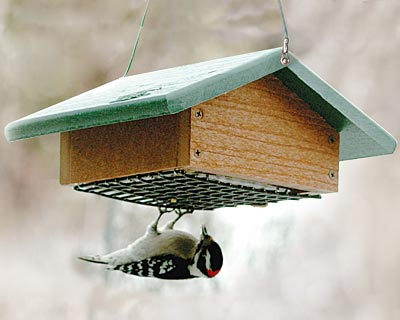
- Upside-down feeders — the cake is accessible only from underneath. Woodpeckers and nuthatches hang below it without difficulty. Starlings essentially cannot. This is the most reliable exclusion there is.
- Tail-prop feeders — an extended panel below the cage gives a woodpecker somewhere to brace its stiff tail feathers, the same way it braces against a tree trunk. It doesn't exclude starlings outright, but it strongly favours the birds you want.
A third option is a caged suet feeder — a wire surround with gaps sized for small birds. That excludes starlings, grackles and squirrels together, at the cost of also excluding the larger woodpeckers.
If starlings are not a problem where you are, ignore all of this and buy on capacity and material instead.
The 10 Best Suet Feeders in 2026, Reviewed
1. Audubon Recycled Plastic Upside-Down Suet Feeder — Best for Beating Starlings
The cake sits horizontally with access only from below, so a bird has to hang underneath to feed. Downy and hairy woodpeckers, nuthatches and chickadees do this without thinking about it. Starlings, which feed upright, mostly give up and leave.
Built from recycled poly lumber rather than wood — it will not rot, split, or need re-oiling, and it washes clean, which matters more with suet than with seed because rendered fat goes rancid on a surface that cannot be scrubbed.

👉 Shop the Upside-Down Suet Feeder — $38
2. Going Green Suet Feeder with Tail Prop — Best for Woodpeckers
The extended red panel below the cage is not decoration. A woodpecker feeds by bracing its stiff tail against a surface and pushing upward with its legs — exactly how it works a tree trunk. Give it that surface and it will settle in and feed properly instead of snatching and leaving.
At $24 this is the cheapest way to find out whether you have woodpeckers within range. Most people are surprised.

👉 Shop the Tail Prop Suet Feeder — $24
3. Coppertop Double Suet Cage — Best Value
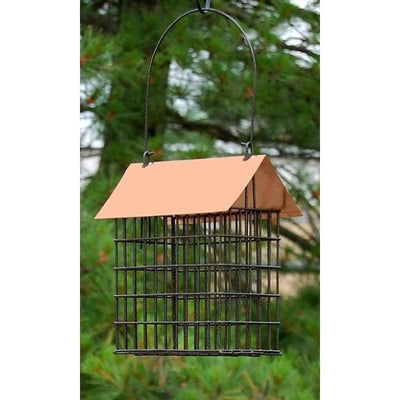
Two cakes side by side, which halves how often you go outside in January and lets two birds feed without arguing. The copper-toned roof keeps rain off the cakes — wet suet spoils quickly and birds abandon it.
The most feeder you can get for the money on this list.

👉 Shop the Coppertop Double Suet Cage — $26
4. Caged Double Suet Feeder — Best for Excluding Large Birds
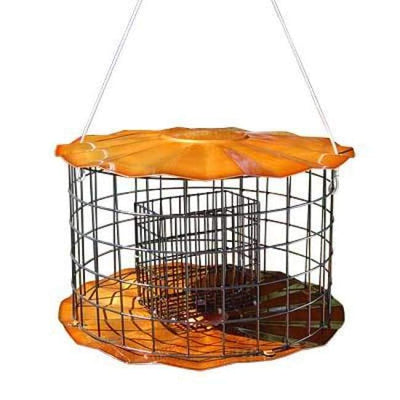
A wire cage around two suet cakes. Chickadees, nuthatches, titmice and downy woodpeckers pass through the gaps; starlings, grackles, jays and squirrels do not. If your suet is disappearing overnight and you would rather have the small birds than the big ones, this is the answer.
The trade-off is real: it will also keep out hairy and red-bellied woodpeckers, which are too large for the gaps. Choose it knowing that.

👉 Shop the Caged Double Suet Feeder — $64
5. Cedar Hopper Bird Feeder with Suet Cages, Large — Best Seed-and-Suet Combo
Seed in the hopper, a suet cage on each side. One hook, one refill trip, and you cover both audiences — the finches and cardinals on the seed, the woodpeckers and nuthatches on the suet, often at the same moment.
Cedar is the right material outdoors: naturally rot- and insect-resistant with no chemical treatment, so it survives a decade of winters. There is a smaller version at $35 for compact gardens.

👉 Shop the Large Cedar Hopper with Suet Cages — $51
Building a whole station around suet? Our 94" Multi-Hook Bird Feeding Station Pole Kit ($89) includes a wire suet cage alongside two seed tubes and a peanut feeder, on a six-hook pole with a 5-prong ground stake. Hang the suet cage on its own hook away from the seed tubes, and if starlings arrive, swap it for the upside-down feeder at #1.
6. Window Suet Feeder — Best for Close-Up Viewing
Suction-mounts to the glass and puts a woodpecker roughly a foot from your face. Watching a downy woodpecker work a suet cake at that distance — you can see the tongue — is a completely different experience from watching one across a lawn.
It is also the answer if you have no garden. A window is all this needs.

👉 Shop the Window Suet Feeder — $38
7. Recycled Plastic Suet Log Feeder — Best Natural Look
A log-shaped feeder with drilled wells you pack with suet dough or plugs. Because the bird clings to a vertical surface and works the food out of a hole, it mimics natural bark foraging closely — woodpeckers, nuthatches and creepers take to it immediately.
Made from recycled poly rather than real wood, so the wells never soften or rot and the whole thing scrubs clean.

👉 Shop the Suet Log Feeder — $57
8. Going Green Peanut or Large Suet Cake Feeder — Most Versatile Fill
Takes a large suet cake or shelled peanuts, so you can switch food with the season — suet through the cold months, peanuts in spring when birds are feeding young and want protein rather than fat.
👉 Shop the Peanut or Large Suet Cake Feeder — $52
9. Large Double Hopper Seed and Suet Feeder — Highest Capacity
The one to buy if refilling is what you actually dislike. A deep double hopper plus suet cages, sized so a busy garden runs for days rather than a day.
👉 Shop the Large Double Hopper — $126
10. Deluxe Dual Suet Seed Hopper — Best Premium
Handcrafted in the USA, with two suet cages and a seed hopper in one piece. This is a permanent garden fixture rather than a seasonal purchase — the sort of feeder that is still working in fifteen years and looks better for the weathering.

👉 Shop the Deluxe Dual Suet Seed Hopper — $226
When to Put Suet Out — and When to Take It In
Hang it in September. Not December. Birds establish their winter feeding circuit in early autumn, well before they need it, and a feeder that appears in the middle of a cold snap has missed the moment. Get it up before the weather turns and it will be busy when the weather does.
Switch to no-melt suet above about 70°F. Standard suet is rendered fat and it softens, drips and goes rancid in summer heat — and rancid fat can smear a bird's feathers, which is genuinely harmful. No-melt cakes are formulated to hold their shape. If in doubt, take the suet down for the hottest weeks and put seed out instead.
Mount it near cover, on or near a trunk. Suet birds are bark foragers. A feeder attached to a tree trunk, or hanging within a few feet of one, gets found far faster than the same feeder out in the open on a pole.
Scrub it between cakes. Fat residue builds up in the mesh and turns rancid. Hot water and a stiff brush every few weeks is enough — no detergent needed.
Frequently Asked Questions
What is the best suet feeder?
It depends on your problem. If starlings are emptying your feeder, an upside-down suet feeder is the only design that reliably excludes them. If you want woodpeckers specifically, choose a tail-prop feeder that gives them somewhere to brace their tail. If neither is an issue, a double suet cage gives you the most feeding capacity for the least money.
How do I stop starlings eating all the suet?
Use an upside-down feeder, where the cake can only be reached from below. Starlings feed upright and cannot hang underneath for long; woodpeckers, nuthatches and chickadees do it easily. A caged suet feeder also works, though it excludes larger woodpeckers along with the starlings. Switching to a pure-suet cake with no seed or fruit mixed in helps too, as starlings are less interested in plain fat.
What birds eat suet?
Woodpeckers of every kind — downy, hairy, red-bellied, northern flicker — plus nuthatches, chickadees, titmice, brown creepers, Carolina wrens, and in winter sometimes warblers and kinglets. Most of these are bark foragers that eat few or no seeds, which is why a suet feeder adds species a seed feeder never will.
When should I put out suet?
Hang it in early autumn, around September. Birds map their winter feeding route before they need it, so a feeder that is already up when the cold arrives gets used immediately. Suet can stay out year-round in most climates if you switch to no-melt cakes for the summer.
Can I use suet in summer?
Yes, but only no-melt suet. Standard rendered-fat cakes soften and go rancid above roughly 70°F, and melted fat can coat a bird's feathers and damage their insulation. No-melt formulations hold their shape in heat. If you are unsure, take suet down through the hottest weeks.
Where should I hang a suet feeder?
On a tree trunk or within a few feet of one, ideally in partial shade. Suet-eating birds forage on bark, so they find a feeder near a trunk far faster than one out in the open. Shade also slows the fat spoiling. Keep it 10 feet from any surface a squirrel can jump from.
Where to Go Next
👉 Shop all suet feeders and cages — 18 designs, from $24
👉 Want the birds rather than the feeder type? Read the best woodpecker feeders guide.
👉 Building a full winter station: heated bird baths · feeding poles and stations · cedar feeders
👉 Want seed, peanuts and suet in one purchase? The Tall Sterling Heavy-Duty Triple Bird Feeder Set bundles a seed tube, peanut mesh cylinder and suet ball feeder in one heavy-duty 3-pack.
Learn more about backyard bird species at the Cornell Lab of Ornithology.