Best Platform Bird Feeders in 2026 — Fly-Through & Tray Feeders Ranked
Quick answer: for most gardens buy the Rustic Farmhouse 3in1 Platform Feeder ($39.23) — it has a roof, and it hangs, pole-mounts or post-mounts, so you can put it at a height you will actually keep clean. Want the classic open-sided look? The Going Green Fly Through ($59.73) is recycled poly and rinses clean in seconds. Busy garden? The Large Handmade Fly-Through ($82.00) holds the most seed on this list.
Why Platform Feeders Out-Draw Every Other Feeder Type
A tube feeder is a machine with rules. A bird has to land on a perch of a particular size, face a port of a particular width, and be light enough not to trip the mechanism. Every one of those rules turns some species away.
A platform feeder has no rules. It is a flat surface with food on it. Anything that can land can eat — chickadees and finches, yes, but also the birds a tube feeder quietly excludes: cardinals, juncos, towhees, mourning doves, jays, and white-throated and white-crowned sparrows. Most of those are ground foragers by instinct, and a raised open tray is the nearest thing to how they naturally feed.
That matters most from September onward. Juncos and winter sparrows arrive in numbers as the weather turns, and they are exactly the birds that will ignore a hanging tube all winter and feed on a platform every day.
The same openness that brings them in is also the design's one real weakness — and it is worth understanding before you choose, because it decides which feeder you should buy.
The 8 Best Platform Bird Feeders in 2026 at a Glance
| Feeder | Best for | Price |
|---|---|---|
| Rustic Farmhouse 3in1 Platform Feeder | Best overall · roof + 3 mounting options | $39.23 |
| Going Green Fly Through, Red | Best fly-through · easiest to clean | $59.73 |
| Large Handmade Fly-Through | Busy gardens · largest tray | $82.00 |
| Hexagon Cedar Bird Feeder Tray | Best open tray · best visibility | $52.00 |
| Audubon Going Green Double Platform | Two seed types at once | $64.71 |
| Vintage Umbrella Hanging Feeder | Best budget · best-looking | $29.00 |
| 3in1 Platform Bird Feeder | Plain-finish 3-in-1 | $47.78 |
| Fly Thru Platform Bird Feeder | Classic traditional silhouette | $76.47 |
Prices are current at the time of writing — the product page always shows today's price. Free shipping on every one.
Fill It Like a Plate, Not a Pantry
This is the section other platform feeder guides leave out, and it is the difference between a feeder that becomes the best thing in your garden and one you take down in six weeks.
A tube or hopper feeder is storage. Seed sits in a sealed column, stays dry, and trickles out as birds eat it. A platform feeder stores nothing. Everything you put in it is exposed — to rain, to snow, to droppings, and to birds standing directly in the food while they eat.
So the instinct almost everyone has on day one — fill the big tray to the brim so you do not have to do it again — is precisely the wrong one. A loaded tray after two days of rain is wet seed sitting in bird droppings, and that is how feeders grow mould and spread disease. Salmonellosis and other feeder-borne illness are consistently traced back to dirty, damp feeding surfaces rather than to the food itself.
The rule is simple: put out what your birds will clear in a day. Top it up daily rather than loading it weekly. It takes ten seconds and it removes the entire problem.
Three buying decisions follow from that, and they should drive your choice more than looks or capacity:
- A roof pays for itself. Fly-through and roofed platform designs keep most rain off the seed, which is the single biggest thing standing between you and a weekly clean-out. A completely open tray is a fine choice, but only if you accept tipping it out after every storm.
- Buy the tray you can reach. You will scrape this feeder often. One mounted where you need a ladder gets cleaned twice a year, which is the same as never. That is why 3-in-1 feeders that hang, pole-mount or post-mount are worth more than their price difference — you pick the height that suits you, not the one the feeder dictates.
- Size for your traffic, not your ambition. A large tray in a quiet garden is a mould box. Match capacity to the number of birds you actually get, and buy bigger only once the small one is emptying daily.
One more thing worth checking on the product page before you buy: whether the tray bottom is screened or solid. A mesh or slotted bottom drains after rain. A solid one holds a puddle until you tip it out.
The 8 Best Platform Bird Feeders in 2026, Reviewed
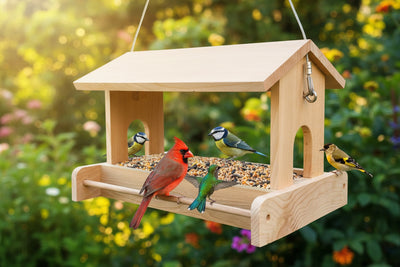
1. Rustic Farmhouse 3in1 Platform Bird Feeder — Best Overall
Three mounting options in one box: hang it, drop it on a pole, or fix it to a post. That is the whole reason it leads this list. Everything above about keeping a platform feeder clean depends on being able to reach it, and this is the feeder that lets you decide where reachable is in your garden rather than committing to a hook eight feet up.
It has a roof, so most rain stays off the seed, and the farmhouse styling means it reads as deliberate on a patio rather than purely functional. At $39.23 it is also the cheapest roofed 3-in-1 here.

👉 Shop the Rustic Farmhouse 3in1 Platform Feeder — $39.23
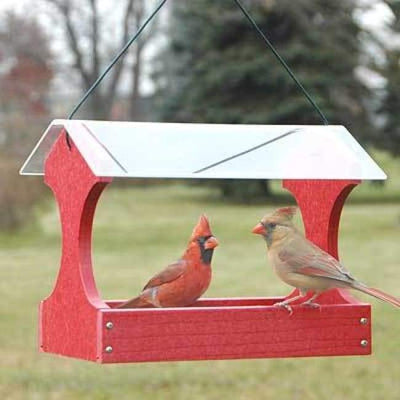
2. Going Green Fly Through Bird Feeder, Red — Best Fly-Through
The classic fly-through shape: a roof above, open on all four sides, birds entering and leaving in any direction. That openness does something specific — it stops one dominant bird holding the whole feeder, because there is no single entrance to defend. Cardinals and jays coexist on a fly-through in a way they will not on a tube.
It is built from recycled poly lumber rather than timber, which matters more here than on most feeders: this is the surface you will be scrubbing, and poly does not absorb, soften or stain the way damp wood does. Hose it, wipe it, refill it.

👉 Shop the Going Green Fly Through — $59.73
3. Large Handmade Fly-Through Bird Feeder — Best for Busy Gardens
BIRDLOVER's own handmade fly-through, with the largest seed tray on this list. Read the section above before you buy it: high capacity is the right call when you have the traffic to clear it daily, and the wrong one when you do not.
If your current feeder is empty by mid-morning, this is the upgrade. Roofed, open on all sides, and handmade rather than moulded.

👉 Shop the Large Handmade Fly-Through — $82.00
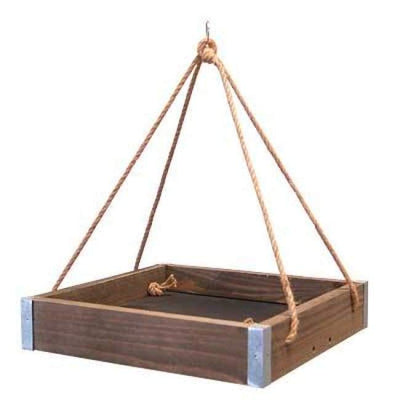
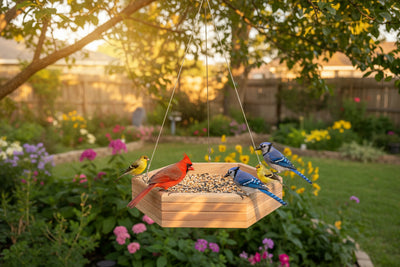
4. Hexagon Cedar Bird Feeder Tray — Best Open Tray
A handmade cedar tray with no roof — the purest form of the design, and the one that shows birds off best because nothing sits between you and them.
Cedar is the right timber for an uncovered feeder: naturally rot- and insect-resistant without chemical treatment, so it survives the wetting and drying an open tray goes through. The trade-off is the one from the section above — with no roof you are committing to tipping it out after rain. Worth it for the look and the visibility.

👉 Shop the Hexagon Cedar Feeder Tray — $52.00
5. Audubon Going Green Double Platform Bird Feeder — Best for Two Seed Types
Two platforms rather than one, which solves a problem single-tray feeders create: everything ends up mixed together. Put black oil sunflower on one level and safflower on the other and you can give cardinals what they want while offering squirrels nothing they like.
Two levels also spread the birds out, which cuts down the squabbling you get when a mourning dove parks itself in the middle of a single tray.

👉 Shop the Audubon Double Platform Feeder — $64.71
6. Vintage Umbrella Hanging Bird Feeder — Best Budget and Best-Looking
The cheapest feeder here and arguably the prettiest — a rustic metal seed tray under an umbrella-shaped canopy that keeps rain off without walling anything in.
Metal has a practical advantage on a hanging feeder: it wipes down completely and there is nothing for damp to soak into. At $29.00 it is also the sensible way to find out whether platform feeding suits your garden before spending more.

👉 Shop the Vintage Umbrella Hanging Feeder — $29.00
7. 3in1 Platform Bird Feeder — Most Flexible Mounting
The plain-finish version of the pick at the top of this list — the same hang, pole-mount or post-mount flexibility, without the farmhouse styling. If you want the function in a design that disappears into the garden rather than decorating it, this is the one.
Honest note: the Rustic Farmhouse above does the same job for less. Choose this one on looks, not on features.

👉 Shop the 3in1 Platform Bird Feeder — $47.78
8. Fly Thru Platform Bird Feeder — Classic Design
A straightforward roofed fly-through with an open tray beneath, and the design most people picture when they think of a bird feeder in a garden. No mechanism, nothing to jam, nothing for a bird to learn.
Buy it if you want the traditional silhouette. The Going Green above covers the same ground for less if you do not mind recycled poly.

👉 Shop the Fly Thru Platform Feeder — $76.47
Where to Put a Platform Feeder — and What to Fill It With
About five feet up. High enough to keep an open tray out of easy reach of cats, low enough that you can scrape and refill it without fetching anything. It also suits the birds a platform is for — ground foragers are comfortable feeding low.
Ten feet from any launch point. Squirrels jump further than people expect. Keep the tray at least ten feet clear of fences, branches, sheds and railings, and fit a baffle to the pole. An open tray is the easiest feeder in the garden for a squirrel to use, so siting does more work here than on any other design.
Cover nearby, but not overhead. Birds want a shrub or low branch within a few yards to duck into. Directly overhead is different — branches above a platform drop droppings and debris straight into the food.
What to fill it with. Black oil sunflower brings the widest range of species. Safflower is the cardinal's favourite and is generally ignored by squirrels and grackles. White proso millet is what juncos, doves and native sparrows are actually looking for. Shelled peanuts pull in jays, nuthatches and woodpeckers. A platform is the one feeder that handles all of them, including the fruit and mixes that clog a tube.
What to leave out. Cheap mixes heavy with red milo and cracked corn. Birds sort through them, throw most of it onto the ground, and you are left with a wet tray of rejected filler.
Frequently Asked Questions
What is a platform bird feeder?
A platform feeder — also called a tray feeder — is an open, flat surface that holds seed, with no ports, tubes or mechanisms. Birds land directly on the food. Some models are completely open, others have a roof above the tray. Because there is nothing for a bird to learn or cling to, platform feeders are usable by more species than any other feeder design.
What birds does a platform feeder attract?
Far more species than a tube feeder. Cardinals, juncos, mourning doves, jays, towhees, and white-throated and white-crowned sparrows all feed readily on a platform and often ignore tube feeders entirely, because they are ground foragers by nature. Chickadees, finches, nuthatches and woodpeckers use platforms too, so you gain species without losing the ones you already have.
How much seed should I put in a platform feeder?
Only as much as your birds will clear in a day. A platform feeder does not store seed the way a tube or hopper does — everything in the tray is exposed to rain, snow and droppings. Filling it to the brim leaves damp seed sitting for days, which is how feeders grow mould and spread disease. Top it up daily instead of loading it weekly.
How high should a platform bird feeder be?
About five feet is the usual choice. That keeps an open tray out of easy reach of cats while staying low enough for you to clean and refill it without a ladder, which matters more on a platform than on any other feeder because it needs cleaning more often. Keep it at least ten feet from fences, branches or anything else a squirrel can jump from.
How do I stop squirrels taking over a platform feeder?
Siting and baffles, not the feeder itself — an open tray cannot exclude anything by design. Mount it on a pole at least ten feet from any launch point and fit a baffle below the tray. Switching to safflower helps as well, since squirrels generally dislike it while cardinals prefer it. If squirrels are your main problem, a caged or weight-triggered feeder is the better tool.
How often should I clean a platform feeder?
Roughly weekly in dry weather, and after any heavy rain or snow that soaks the seed. Tip out old seed, scrub the tray with hot water and a stiff brush, and let it dry before refilling. Platform feeders need this more than enclosed feeders because birds stand directly in the food, so droppings and damp seed accumulate in the tray itself.
What is the difference between a platform feeder and a fly-through feeder?
A fly-through feeder is a platform feeder with a roof and open sides, so birds can enter and leave from any direction while the seed stays sheltered. A plain platform or tray feeder has no roof, which gives you a clearer view of the birds but leaves the seed exposed to weather. If you do not want to empty a wet tray after every storm, choose a fly-through.
Where to Go Next
👉 Shop all platform bird feeders — 14 designs, from $29
👉 Want the birds rather than the feeder type? Read the best bird feeders for cardinals guide — cardinals are the species a platform serves best.
👉 Building a full station: feeding poles and stations · squirrel proof bird feeders · suet feeders
Learn more about backyard bird species at the Cornell Lab of Ornithology.