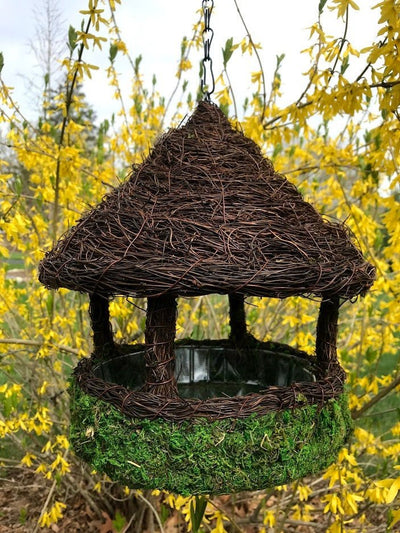
Best Moss Birdhouses & Feeders in 2026 — 4 Picks, and Whether Birds Will Actually Nest in One
Share
A moss birdhouse is almost always bought with the eyes. You see one tucked into planting, looking like it has been there for twenty years, and you want it. That is a perfectly good reason to buy one.
The question arrives later, usually around week three: is anything ever going to live in it?
There is an honest answer to that, and it isn't the one most listings give. Below are the four moss pieces in our range with real prices and honest notes on what each one can and can't do. But read the next section first — it decides which of them you should buy, and it costs nothing.
Will a Bird Actually Nest in a Moss Birdhouse?
Sometimes. And whether it does has almost nothing to do with the moss.
Moss-covered houses are made as garden pieces first. Some of them happen to be built to nest-box proportions and get used; others are ornaments with a hole in the front and never will be. The moss itself is neutral — birds have no objection to it, and a well-camouflaged cavity is if anything a slightly safer one. What decides occupancy is five things underneath the moss, and you can check every one of them with a tape measure.
1. The entrance hole decides the species — and therefore everything
This single measurement is the whole nest box. Too small and no bird can enter; too large and you have built a house for starlings. These are the standard sizes:
| Entrance hole | Admits |
|---|---|
| 1⅛ in (2.9 cm) | House wrens, chickadees |
| 1⅜ in (3.5 cm) | Chickadees, wrens, nuthatches, titmice, tree swallows — too small for starlings |
| 1½ in (3.8 cm) | Eastern bluebirds, tree swallows |
| 1⁹⁄₁₆ in (4.0 cm) | Western and Mountain bluebirds |
The useful sweet spot for a small garden is 1⅛ to 1⅜ inches. That range covers the birds most likely to take a hanging house, and it physically excludes European starlings, which need roughly 1½ inches to get in. Decorative houses very often have a hole well under an inch, which is charming and ornamental and will never be a nest.
2. Depth from the hole down to the floor
Aim for five to six inches of drop below the entrance. This is the measurement that quietly protects the brood: a shallow decorative cavity puts eggs and nestlings within reach of a raccoon's arm or a cat's paw at the opening. Depth is also why a house should hang rather than sit — a box on a flat surface gives a predator somewhere to stand and work.
3. No perch under the hole
Cavity-nesting birds do not use perches. They grip the lip of the entrance and go straight in — that is what their feet are for. A dowel perch below the hole does one thing reliably, which is give house sparrows and predators a foothold they would not otherwise have. Decorative birdhouses have perches because a perch looks like a birdhouse in a photograph, not because a bird asked for one. If a house you like has one, it can usually be snapped or unscrewed off.
4. Drainage and ventilation
Small holes in the corners of the floor, and a gap or holes under the roof overhang. Without drainage a wet spring floods the cavity; without ventilation a still July afternoon turns it into an oven. Both failure modes kill broods and neither is visible in a product photo.
5. It has to open
Old nesting material holds parasites and needs to come out once the season is over. A house that is glued, nailed or moss-sealed shut is a one-season house — pleasant to look at, but you cannot maintain it.
Here is the part most sellers skip
Where a maker has not stated the entrance diameter or the internal depth, we are not going to guess it for you. On handcrafted moss pieces those figures often genuinely vary from one piece to the next, which is the flip side of every one being unique. So we have left them out of the table below rather than invent them.
What we can tell you is what to do about it. Measure the hole when it arrives against the table above. If it comes up short, the piece is garden art — site it as garden art and enjoy it as such. That is not a failure and it is not a waste of money.
The setup that actually makes people happy is both, not one: a moss piece somewhere you look at every day, and a plain purpose-built box in a quiet corner twenty feet away where the birds will actually raise a family. Our wren houses and bluebird houses are built to the dimensions above. Asking one beautiful object to do both jobs is what disappoints people.
Keeping the Moss Looking Alive
The moss on pieces like these is real moss that has been preserved rather than living moss. It needs no soil, no light and no feeding — but it is also not weatherproof, and this is where most of the disappointment in this category actually comes from. Two things degrade it, in this order:
- Direct afternoon sun is the worst of the two. It bleaches preserved moss from green toward grey and dries it until it crumbles at the edges. A spot that gets gentle morning light and shade for the rest of the day will keep its colour for years longer than one baking on a south-facing fence.
- Driving rain mats the moss flat and, over enough seasons, strips it from the high points. Ordinary rainfall is fine; it is the relentless wind-driven kind that does the damage.
The fix for both is the same and it is free: hang it where something is already above it. Under an eave, inside a porch, beneath a dense tree canopy, on the sheltered side of a wall. Preserved moss that is out of the sun and out of the weather essentially stops changing.
If it does start to look dusty or flat, a light mist of water from a spray bottle lifts the texture and deepens the colour again. Mist it — do not soak it, and do not scrub it.
The 4 Best Moss Birdhouses & Feeders — Compared
Prices are current at the time of writing (September 2026). Every piece here is handcrafted and one of a kind, so expect natural variation in moss colour and texture from the photographs. Dimensions and entrance sizes are listed only where the maker states them; where a figure isn't given, we've left it blank rather than guess.
| Piece | Price | Type | Material | Mounting | Best for |
|---|---|---|---|---|---|
| Natural Moss Birdhouse, LOFT Design | $97.00 | Birdhouse | Natural moss over a handcrafted frame | Hanging fixture included | Best overall |
| Handmade Stone Birdhouse, Moss Covered | $37.00 | Birdhouse | Handmade stone with natural moss | Hanging rope optional, same price | Best value & exposed spots |
| Moss Hut Bird Feeder | $77.00 | Feeder | Natural moss and branching wood | Open platform | Feeding the widest range of birds |
| MossVine Bird Feeder | $52.00 | Feeder / nesting material | Natural moss and vine | Hanging | Nesting season |
1. Natural Moss Birdhouse, Whimsical LOFT Design — Best Overall
$97.00 · natural moss over a handcrafted frame · hanging fixture included
This is the piece the whole category is really about, and the reason to pay attention to it is one word in the description: the moss is real, not moulded. That matters more than it sounds. Most of what ranks for "moss birdhouse" online is resin or foam with a moss-effect finish, and the tell is repetition — a moulded surface has a pattern that repeats across the piece and across every other piece in the batch. Real moss has irregular depth, tonal variation and edges that do not resolve into a pattern, which is exactly why it reads as something that grew there.
The loft-style form gives it more vertical presence than a conventional box, so it works hung at eye level where you actually see it rather than tucked up under a roofline.
Trade-off: it is the most expensive piece here, and like all moss-on-wood it wants a sheltered position. If the only spot you have is exposed to full afternoon sun or driving rain, the stone house below will survive it better and costs a third as much.
View the Natural Moss Birdhouse →
2. Handmade Stone Birdhouse, Moss Covered Fairy House — Best Value
$37.00 · handmade stone with natural moss · three colourways · with or without hanging rope
Stone does something moss-on-wood cannot: it does not rot, warp, swell or get chewed. If the spot you have in mind is more exposed than ideal, this is the piece that will still be there in five years.
Weight matters for a second reason that rarely gets mentioned. A light hanging house spins and swings in wind, and a nest site that moves unpredictably is one birds abandon. Stone hangs steady.
It comes in three colourways — Dark Grape Purple, Purple Moss Trim and Blue Moss Trim — and in two styles, with or without a hanging rope, at the same $37 either way. Choose by destination rather than budget: take the rope if it is going into a tree or on a bracket, skip it if it is being set into a rock garden, on a wall top or among planting, where a rope is just something to tidy away.
Trade-off: it is sold as a mini piece, so set your expectations at small-scale garden feature rather than full-size nest box, and measure the entrance against the table above before you count on it being nested in.
View the Handmade Stone Birdhouse →
3. Moss Hut Bird Feeder, Natural Branching Platform — Feeds the Widest Range of Birds
$77.00 · natural moss and branching wood · open platform
Tube feeders with small ports quietly turn away most of the birds people actually want to see. Cardinals, jays, doves, towhees and thrushes need somewhere to stand, and an open platform gives them that. Because nothing has to fit through a hole, you can also put out mealworms, fruit or broken-up suet — foods no port feeder can offer.
The branching structure is the interesting part. Multiple landing points mean arriving birds have somewhere to wait rather than displacing whoever got there first, so you end up watching several birds at once instead of a queue and a squabble.
Trade-off: an open platform is open to rain and open to squirrels. Fill it shallow and often rather than deep and rarely. On a moss piece specifically, keep the food on the platform and not on the moss — wet seed sitting in moss is the one thing that will spoil both. Site it under cover and that problem disappears. If open feeding is the appeal, our platform bird feeders collection has purpose-built versions with drainage.
View the Moss Hut Bird Feeder →
4. MossVine Bird Feeder, Natural Nesting Material Hanging Planter — Best for Nesting Season
$52.00 · natural moss and vine · hanging · doubles as a planter
This is the one genuinely seasonal piece in the range, and the idea behind it is better than it first appears. Nesting material is a real constraint in a well-kept garden. Moss, fine vine and plant fibre are exactly what small birds line their nests with — and a garden with no leaf litter, no old grass and no moss left standing simply doesn't have any. Offering natural material in spring is a long-established way to get birds working your garden rather than the neighbour's.
Timing is the whole trick: put it out in late winter, before nest building starts, not in the middle of it.
One thing worth saying plainly, because it is offered as helpful advice all over the internet and it is bad advice: do not put out dryer lint, human hair or cut string. Lint holds water and disintegrates once it is wet, hair and long fibres wrap around nestlings' legs and toes. Natural moss and plant fibre are what you want, which is the whole point of this piece.
Trade-off: it is the least conventional feeder of the four. Treat it as a habitat piece that also holds food rather than as your main seed feeder — it has nothing like hopper capacity.
View the MossVine Bird Feeder →
How to Choose Between Them
Strip away the styling and there are three decisions:
- House or feeder? A moss house is a permanent garden feature that may or may not be nested in. A moss feeder starts working the week it goes up, because a bird that will not commit to a nest site will still come and eat.
- Sheltered spot or exposed? Stone handles exposure; moss on wood and moss on vine want an eave, a porch or a canopy over them. Pick the spot first, then the piece — that order round saves the moss.
- Decoration or fledglings? If you want a nest, measure the entrance hole against the table above and buy a purpose-built box as well. The two together cost less than replacing a moss house that was never going to be a nest box in the first place.
Every piece on this page ships free.
Frequently Asked Questions
Will birds actually nest in a moss birdhouse?
Some do, but it depends on the construction rather than the moss. Birds need an entrance hole of the right diameter for their species, roughly five to six inches of depth below that hole, drainage in the floor and ventilation under the roof. Many moss-covered houses are made as garden ornaments and have an entrance under an inch across, which no cavity-nesting garden bird can use. Measure the hole before you count on it. Birds have no objection to moss itself — a well-camouflaged cavity is arguably a safer one.
What size entrance hole does a birdhouse need?
It depends entirely on the species you want. 1⅛ inches suits house wrens and chickadees. 1⅜ inches adds nuthatches, titmice and tree swallows while still being too small for European starlings, which need about 1½ inches. 1½ inches is the size for Eastern bluebirds, and 1⁹⁄₁₆ inches for Western and Mountain bluebirds. For a general small-garden box, 1⅛ to 1⅜ inches is the most useful range because it excludes starlings.
Is the moss on a moss birdhouse real?
On the pieces in this guide it is real natural moss, preserved rather than living. Preserved moss keeps its colour and texture without soil, water or light, but it is not the same as a moulded resin or foam finish made to look like moss. The quickest way to tell them apart is to look for repetition: a moulded surface repeats the same pattern across the piece, while real moss varies in depth and tone and has edges that do not resolve into a pattern.
Where should I hang a moss birdhouse?
Somewhere with something above it — under an eave, in a porch, beneath a dense tree canopy or on the sheltered side of a wall. Preserved moss degrades fastest in direct afternoon sun and in wind-driven rain, so a position with gentle morning light and shelter for the rest of the day will keep it looking right for years longer. If the house is meant to be nested in as well as looked at, put it somewhere quiet and away from the busiest part of the garden, and hang rather than shelf-mount it so predators have nowhere to stand.
How do I stop the moss going brown or falling off?
Position does most of the work: out of direct afternoon sun and out of driving rain. Beyond that, a light mist of water from a spray bottle lifts flattened moss and deepens the colour when it starts looking dusty. Do not soak it, do not scrub it and do not apply any kind of preservative or varnish — anything you spray onto a birdhouse is sitting inches from where birds will be.
Can I leave a moss birdhouse outside all winter?
Yes, and a sheltered one will be fine. Winter is actually when houses earn their keep beyond nesting season, because small birds roost in cavities on cold nights, sometimes several to a box. The only reason to bring a piece indoors over winter is if it is purely decorative and sitting somewhere fully exposed, where a hard season will flatten the moss. If anything is roosting or nesting in it, leave it alone.
Do moss birdhouses need cleaning?
If birds use them, yes — once a year, after the last brood has fledged. Old nesting material holds parasites that carry into the next season. Take out the old nest, brush the cavity clean, and let it dry fully before rehanging. Avoid detergents and never use bleach inside a box you cannot rinse and dry thoroughly. This is exactly why a house that cannot be opened is a one-season house, and worth checking before you buy.
What is the difference between a moss birdhouse and a nesting material feeder?
A birdhouse is the cavity a bird nests inside. A nesting material feeder holds loose natural fibre — moss, plant fibre, fine vine — that birds carry away to build a nest somewhere of their own choosing, often nearby. They solve different problems and they work well together: the feeder supplies the material in late winter, the house offers a site. Neither replaces the other.
Shop the Full Range
Browse all four pieces — in this order — in our moss birdhouses collection. If it is the natural, low-impact end of the range that brought you here, our guide to the best eco-friendly birdhouses covers recycled and natural-material designs more broadly. And if this guide has convinced you that you want fledglings as well as a beautiful garden, start with our best wren houses guide — wrens are the species most likely to take a small hanging box in an ordinary garden.
Prices listed are current at the time of writing and may change. Free shipping applies to all orders.