Do Smart Bird Feeders Actually Work? An Honest 2026 Review
Smart bird feeders are everywhere in 2026. Here is an honest look at what they do well, what the marketing leaves out, and when a handcrafted feeder is the better buy.
What Is a Smart Bird Feeder?
A smart bird feeder is a seed feeder fitted with a built-in camera, WiFi connectivity, and AI-powered bird recognition software. The best-known names in 2026 are Bird Buddy, Netvue Birdfy, and Happy Birdy. Prices vary widely by model, and what separates them is less the brand than what each one actually publishes — resolution, battery capacity, weather rating, and whether cloud storage costs extra. All promise to photograph and identify every bird that visits your garden and send alerts to your phone.
They work. The cameras are genuinely good — HD resolution, decent night vision, and the AI identification is impressively accurate across hundreds of North American species. If photographing and identifying birds is your primary goal, a smart feeder does that job well.
But there are a few things the marketing doesn't tell you.
The Hidden Costs of Smart Bird Feeders
The sticker price is rarely the whole cost. Most smart feeders either require a subscription for cloud storage and the full AI feature set, or they limit your photo and video history without one. Check the current subscription tiers before you buy, and multiply by the years you expect to own it — over a five-year life it can approach the cost of the hardware again.
WiFi dependency is the other issue. Smart feeders need a stable signal, and a feeder sits outdoors, often at the far end of a garden with at least one exterior wall between it and the router. That is exactly where home WiFi is weakest, and a weak signal means dropped connections, missed alerts, and gaps in recording. Check your signal strength at the spot you plan to hang it before you commit. A dual-band model that can use either 2.4 GHz or 5 GHz gives you more room to solve this than a 2.4 GHz-only one.
And unlike a cedar feeder that gets more beautiful as it weathers, a smart feeder has a technology shelf life. The AI software, the app, the cloud infrastructure — all of it will eventually be discontinued, updated incompatibly, or simply shut down. Buy on the assumption that you are paying for the next few years of use, not for a decade.
What the Birds Think
Here's the part that gets overlooked: birds don't care about cameras.
What birds care about is seed quality, feeder safety, perch stability, and material comfort. Natural cedar regulates temperature — warmer in early spring, cooler in summer heat — in a way that thin plastic simply cannot.
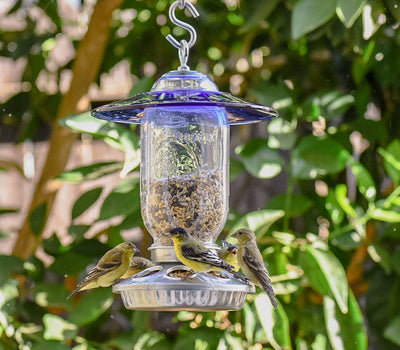
Feeder shape matters more than any of the technology. Many smart feeders are narrow tube or hopper designs with small plastic perches, which suit clinging birds like chickadees and finches. Cardinals, jays, doves and other larger or ground-feeding species need a wide flat surface to land on, and they will pass a narrow perch by. If you are buying a camera feeder, look for one with a full-width perch bar or tray rather than a stub perch — it makes a real difference to who turns up. An open platform or fly-through feeder brings in a wider range of species still, whatever it is made of.
You Don't Need Hardware to Identify Birds
One of the main selling points of smart feeders is AI bird identification. But the free Merlin Bird ID app by the Cornell Lab of Ornithology does the same thing — identifying birds by photo, sound, and location — at no cost whatsoever. Point your phone at a bird at the feeder and Merlin identifies it in seconds. No subscription, no WiFi requirement, no hardware outlay.
The Cornell Lab's All About Birds database provides detailed species information, range maps, and behavioral guides for free. For serious birders, eBird lets you log sightings and contribute to citizen science. All free.
Our Honest Recommendation for 2026
If you genuinely love wildlife photography and want a camera-integrated setup, smart feeders are a legitimate choice — but budget for the full cost including subscription, and check your WiFi signal at the feeder's location before buying.
If your goal is attracting the widest variety of birds, seeing more activity, and enjoying a garden feature that lasts a decade rather than a product cycle — a handcrafted natural feeder is the better investment. Specifically, an open platform feeder in cedar or copper will attract more species, more often, in every season, with zero subscription and zero WiFi dependency.
The two are not mutually exclusive. A smart feeder for close-up photography and an open platform feeder for volume and variety is a genuinely good pairing — and it is the setup we would recommend to most people who want both.
The Smart Feeders We Carry
We stock three, and we will tell you plainly what each does and does not publish. Every caveat above still applies: check your WiFi at the spot before you buy, and ask us about subscription terms before ordering if that decides it for you.

Smart Bird Feeder with Camera — $258.84. The largest hopper of the three at 13.1 inches, solar panel over a 5200 mAh battery, and a wide perch tray rather than a narrow plastic perch. Comes with a fruit spike, a mealworm cup and a suet-ball holder, which is how you widen the range of species that turn up on camera. The manufacturer has not published the app name, subscription terms or a weather rating, and we say so on the product page.

Squirrel Proof Bird Feeder Camera — $268.29. A 4 MP camera with an AI squirrel-repelling system, which addresses the single most common complaint about camera feeders: once a squirrel finds one, your phone fills up with footage of the same animal emptying the hopper. The manufacturer has not published how the deterrent works, and we would rather say that than guess.

Waterproof Bird Feeder Camera — $486.54. The one that answers the durability objection above. It publishes an IP65 rating — dust-tight and tested against water jets — along with a 3 MP sensor at 2304 × 1296, dual-band 2.4 GHz and 5 GHz WiFi on an external antenna, two-way audio, and a hopper split into two separate silos. Dual-band matters more than it sounds: the WiFi problem described earlier is exactly what a 5 GHz option near the house, or 2.4 GHz at range, is there to solve.
If you want the nest rather than the feeder, our guide to bird box cameras covers wired and WiFi options that go inside a nest box.
Our Top Natural Feeders for 2026

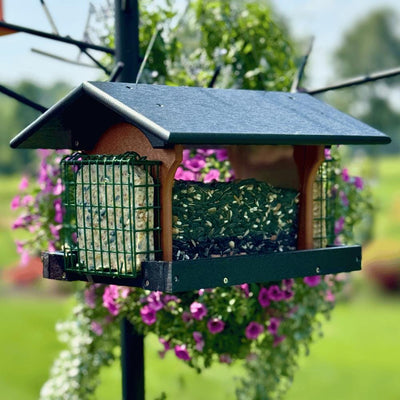
Hexagon Cedar Bird Feeder Tray — Our most versatile open platform feeder. Six landing edges, drainage holes to keep seed dry, 100% natural cedar. Attracts cardinals, jays, finches, doves, and chickadees. No subscription, no WiFi, no tech to break.

Vintage Umbrella Hanging Bird Feeder — Our most-viewed feeder for songbirds. The umbrella canopy keeps seed dry in rain, and multiple perch points welcome finches, chickadees, and cardinals at once. All-metal, zero plastic.

Large Handmade Fly-Through Cedar Feeder — The gold standard for maximum bird activity. Open on all four sides, high-capacity seed tray, solid cedar construction. Attracts the widest range of species of any feeder we carry.
Frequently Asked Questions
Are smart bird feeders worth buying in 2026?
For wildlife photography enthusiasts who want hands-free identification and a constant stream of bird photos, yes — with the caveat that subscriptions and WiFi requirements add ongoing cost and complexity. For most backyard birders focused on attracting and enjoying birds, a quality natural feeder paired with the free Merlin Bird ID app achieves the same result at a fraction of the price.
Which birds do smart feeders attract?
Smart feeders are typically narrow tube or hopper designs that suit small clinging species — chickadees, finches, and sparrows. Their narrow perches make them less appealing to larger species like cardinals, jays, and doves. Open platform feeders attract a wider variety.
How long do smart bird feeders last?
Hardware quality varies, but the bigger limitation is software support. As manufacturers release new models and update apps, older smart feeders lose features or become incompatible. A quality cedar or metal feeder, by contrast, lasts 10–15 years and gets more attractive as it ages. Cedar develops a silver-gray patina; copper develops a rich verdigris — both beautiful outcomes that no plastic feeder can match.
Can I identify birds without a smart feeder?
Absolutely. The free Merlin Bird ID app by the Cornell Lab of Ornithology identifies hundreds of North American species by photo or sound, works offline once downloaded, and requires no subscription. It is arguably the most useful bird identification tool available — and it works with any feeder.
🐦 Explore More at BIRDLOVER
- 🌲 Cedar Bird Feeders & Birdhouses — Naturally rot-resistant, handcrafted, bird-safe
- 🐦 Bluebird Houses & Feeders — NABS-approved nest boxes & mealworm feeders
- 🪟 Window Bird Feeders — Perfect for apartments & small spaces
- 🐿️ Squirrel Proof Bird Feeders — Weight-sensitive, caged & baffle designs
- 🌿 Handmade Bird Feeders — Artisan crafted, not mass produced
- ☀️ Solar Bird Baths & Feeders — No wiring, no running costs
- 🏡 Recycled Cotton Birdhouses — Fair Trade, biodegradable, birds love them
- 🎁 Bird Lover Gifts — Unique gifts for every budget
- 🦅 Platform & Fly-Through Feeders — Attract the most bird species
- 🔩 Bird Feeding Poles & Stations — Build the perfect feeding station