Best Bird Feeding Stations & Poles in 2026 — Setups That Beat Squirrels
Quick answer: the best all-round bird feeding station in 2026 is the Premium Wild Bird Feeding Station Kit — 7'6", four hanging points, and tall enough to baffle properly. If you want the cheapest honest way in, the Essex Feeding Station Kit is $29. If your soil is soft and your last pole leaned, buy the Erva Pole with Ground Auger — the auger is the fix. Ten picks below, plus the part most guides skip: the pole is what beats squirrels, not the feeder.
The 10 Best Bird Feeding Stations & Poles in 2026 at a Glance
Two different buyers land on this page. One wants a complete station — pole, arms, everything, out of one box. The other already owns feeders and just needs something to hang them on that will not fall over. The list below covers both, in that order.
| Station or pole | Best for | Height | Price |
|---|---|---|---|
| Premium Wild Bird Feeding Station Kit | Best overall station | 7'6" | $100 |
| Deluxe Bird Feeding Station Kit | Best mid-range station | — | $76 |
| Jester Premium Station with Feeders | Feeders included | 7'6.5" | $57 |
| Birding Pole with Two Feeders | Best starter set | 7'1.5" | $35 |
| Essex Feeding Station Kit | Cheapest way in | 6'7" | $29 |
| Telescoping Aluminum Tri-Pole | Heaviest loads | Adjustable | $111 |
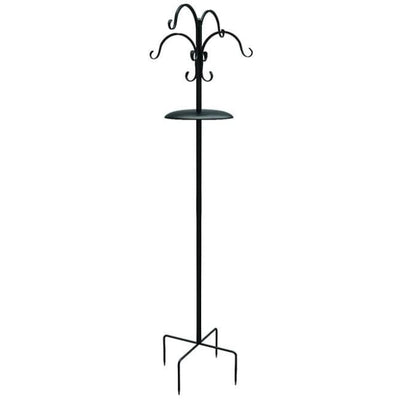
| Erva Pole with Ground Auger | Soft or sandy soil | 6'8" | $63 |
| Deluxe Pole with Ground Sleeve | Permanent installation | — | $58 |
| Three Piece Birding Pole | Best budget pole | 6'8" | $42 |
| Four Arm Extended Reach Hanger | Turning a pole into a station | 45" span | $50 |
Prices are current at the time of writing — the product page always shows today's price. Free shipping and 30-day free returns on every one.
First: The Pole Is the Squirrel Solution, Not the Feeder
Most people buy a squirrel-proof feeder, hang it from a branch, and are surprised when it does not work. The feeder was never the variable. A squirrel that can reach a feeder will eventually get into it; a squirrel that cannot reach it does not need to.
A pole is the only setup that can actually exclude them, and it only works when three things are true at the same time:
- Nothing on the pole to grip. Smooth metal, no brackets or joints in the lower section, no rope or chain running down it.
- A wide baffle four to five feet up. Squirrels jump roughly five feet vertically from the ground, so the baffle has to start above that. Width matters as much as height — a narrow cone can be reached around, which is why a 7.5-inch pole guard works where a small one does not.
- Ten feet of clear air in every direction. Fence, shed roof, deck rail, low branch, the top of a hedge — a squirrel will launch about ten feet horizontally off any of them. This is the condition people get wrong, because it is the one that costs nothing and requires moving the pole.

Get one of the three wrong and the other two stop mattering. That is the whole reason a station out in the open beats an expensive feeder hung by the fence — and it is worth deciding where the pole goes before you choose which one to buy.
👉 If you would rather solve it at the feeder end too, see our squirrel-proof bird feeder guide.
The 10 Best Bird Feeding Stations & Poles in 2026, Reviewed
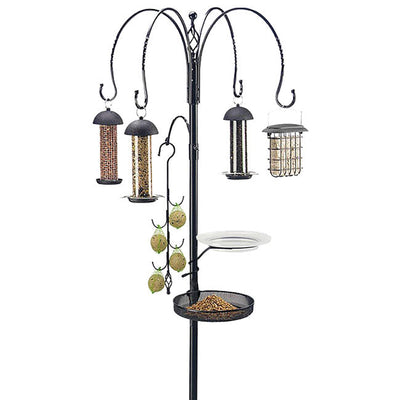
1. Premium Wild Bird Feeding Station Kit, 7'6" — Best Overall
Height is the specification that matters most on a station, and this is one of the few that clears 7'6". That matters because the baffle needs four to five feet of pole below the feeders, and a six-foot station leaves you choosing between a baffle that is too low and feeders you cannot reach.
Four hanging points let you run a tube feeder, a suet cage, a nyjer feeder and a water dish from one position, which is what turns a feeder into a place birds return to. Powder-coated steel, and it takes standard 1-inch accessories.

👉 Shop the Premium Feeding Station Kit — $100
2. Deluxe Bird Feeding Station Kit — Best Mid-Range
The sensible middle. You get the pole, the arms and the mounting hardware in one box, so there is no working out afterwards which adapter you still need — which is the usual reason a station costs more than the advertised price.
Choose this one if you want a complete setup without paying for the tallest option, and you already own the feeders you intend to hang.

👉 Shop the Deluxe Feeding Station Kit — $76
3. Jester Premium Bird Feeding Station with Feeders, 7'6.5" — Feeders Included
A full-height station that arrives with feeders already on it. The reason to want that is not the saving — it is that the feeders are sized and weighted for the arms, so nothing tips or fouls another arm, which is a real annoyance when you assemble a station from mismatched parts.
At 7'6.5" it has the same height advantage as the Premium kit, with a lower entry price because the components are lighter.

👉 Shop the Jester Premium Station — $57
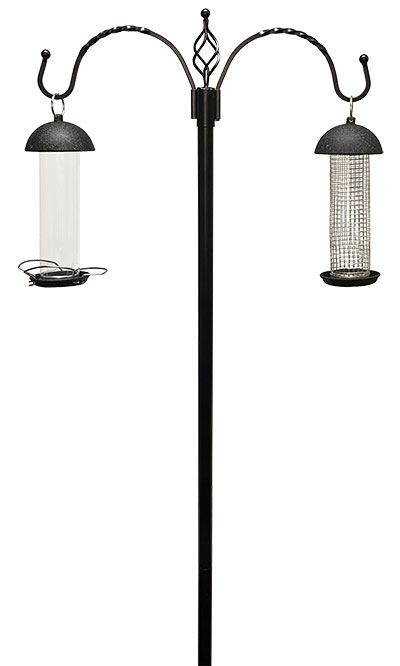
4. Birding Pole with Two Bird Feeders, 7'1.5" — Best Starter Set
Pole plus two feeders for $35 is the least you can spend and still end up with a working setup rather than a project. Two feeders is also the right number to start with: it lets you run seed on one arm and suet on the other, which is the pairing that adds the most species for the least money.
Add a third feeder later — the pole takes standard accessories.

👉 Shop the Birding Pole with Two Feeders — $35
5. Essex Bird Feeding Station Kit, 6'7" — Cheapest Way In
The lowest-cost complete station here. At 6'7" it is shorter than the picks above, which is the honest trade: you can still baffle it, but the baffle sits lower and the clearance rule matters more, so give it a genuinely open position rather than a corner.
For a first feeding station, or a second one at the other end of a garden, it does the job.

👉 Shop the Essex Feeding Station Kit — $29
6. Telescoping Aluminum Tri-Pole with Ground Socket — For the Heaviest Loads
A triangular cross-section resists twisting in wind far better than a round pole of the same weight, which is why this is the one to choose if you intend to hang four full feeders, or a large hopper, or anything with a wide roof that catches gusts.
It ships with a ground socket, and the telescoping sections mean you can set the working height rather than accept whatever the pole came as. Aluminium, so it does not rust.

👉 Shop the Telescoping Tri-Pole — $111 · round-pole adapter, $19
7. Erva Birding Pole with Ground Auger, 6'8" — For Soft or Sandy Soil
If your last pole leaned, this is the pick. An auger is a screw thread that winds into the ground instead of being pushed into it, and it resists two things a plain spike does not: pulling upward, and rotating when a heavy feeder swings on one side.
That makes it the right answer in sandy soil, in ground that goes soft after rain, and anywhere a pole has already failed once. 1-inch outer diameter, so every standard baffle and hanger fits it.

👉 Shop the Erva Pole with Ground Auger — $63
8. Deluxe Birding Pole with Ground Sleeve & Mounting Adapter — Best Permanent Install
A ground sleeve is a socket you sink once and leave in place; the pole drops into it and lifts back out. That is worth having for two reasons — you can pull the pole for mowing or winter storage without losing the position, and the sleeve takes the lateral load instead of the soil around the pole slowly working loose.
The mounting adapter is included, so a birdhouse or a feeder both attach without buying a second part.

👉 Shop the Deluxe Birding Pole — $58 · ground socket on its own, $29
9. Three Piece Birding Pole, 6'8" x 1" O.D. — Best Budget Pole
Three sections that push together, no tools, and a 1-inch outer diameter that fits essentially every baffle, hanger and mounting plate sold for garden birding. At $42 it is the cheapest way to get a proper pole under feeders you already own.
6'8" is enough height to baffle correctly, which is the thing a shorter pole quietly costs you.

👉 Shop the Three Piece Birding Pole — $42
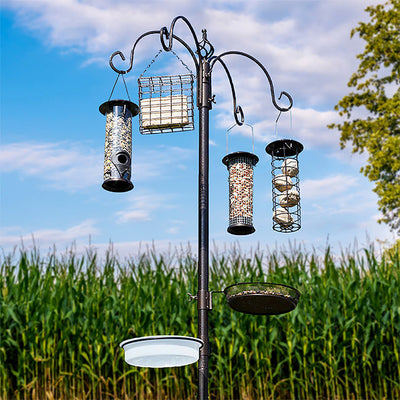
10. Four Arm Extended Reach Hanger, 45" — Turns a Pole Into a Station
This is the part that converts a single pole into a proper feeding station, and it is the accessory most people do not know exists. Four arms on a 45-inch span hold the feeders far enough apart that a jay on one does not clear the others, and far enough out from the pole that a squirrel on the pole cannot reach across.
Fits standard 1-inch poles, including the three picks above.

👉 Shop the Four Arm Hanger — $50
👉 Browse all bird feeding poles & stations →
Why Poles Lean — and How to Stop It
A leaning pole is almost never a weak pole. It is a lever problem at the ground.
Four loaded feeders at six feet is real weight, and it is rarely balanced — one arm always ends up heavier, and wind pushes on feeder roofs like small sails. Every bit of play where the pole meets the soil gets multiplied by the height above it. So the pole tilts a degree, the load shifts further to that side, and it tilts further. Once it starts, it does not stop on its own.
Three fixes, in order of how much they help:
- Use a socket or an auger instead of pushing the pole into the ground. A ground socket spreads the lateral load over a wider column of soil; an auger resists lifting and twisting as well. In sandy or frequently wet soil, this is the only fix that lasts.
- Go at least twelve inches deep, and check vertical before loading. A pole that starts a few degrees off will not correct itself.
- Balance the arms. Put the heaviest feeder opposite the second heaviest rather than next to it. Free, and it removes most of the standing load.
If the ground is genuinely unworkable — solid clay, tree roots, a paved area — mount to a wooden post instead with a 4x4 post bracket and skip the soil question entirely.
Pole Diameter: The Compatibility Spec Nobody Mentions
One inch outer diameter is the de facto standard for garden birding poles. Baffles, multi-arm hangers, mounting plates, seed trays and birdhouse adapters are overwhelmingly built to it, and a half-inch difference makes a part simply unusable rather than merely a loose fit.
Two things worth checking before you buy accessories:
- Triangular and square poles need an adapter. They are more rigid, but round-pole accessories will not clamp to them without a triangular-to-round adapter first.
- A birdhouse is not a feeder mount. If you want a nest box on the pole rather than a feeder, you need a flat mounting plate or a universal pole adapter, not a hook.
Worth adding while you are there: a pole-mounted seed tray catches what the feeders drop, which both keeps the ground clean and brings in cardinals, doves and juncos that will not use a hanging feeder at all.
Purple Martin Poles Are a Different Product
Several of the tallest poles in this collection are built for Purple Martin colonies rather than for feeding stations, and they are not interchangeable. Martin housing goes 10 to 20 feet up with clear flyways on every side, and the poles are designed to be raised and lowered so the colony can be monitored and cleaned — a requirement no feeder pole has.
If that is what you are after, the relevant options are the 8-gourd aluminium pole ($119), the 15-foot telescoping house and gourd pole ($103), the 17-foot DuraCraft pole ($110), the galvanised pulley-system pole ($238), and the 14-foot Quad Pod system ($498).
If you are here to feed chickadees and cardinals, ignore this section — a martin pole is the wrong shape and roughly three times the height you want.
How to Set Up a Station That Actually Gets Used
- Ten feet of clearance, then everything else. Site the pole first. A perfect station in the wrong place is a squirrel feeder.
- But keep light cover within about fifteen feet. Birds queue. A small tree or shrub nearby gives them somewhere to wait and to bolt to, and feeders in completely bare ground get used less than feeders with an escape route.
- Mix feeder types on the same pole. Tube for small seed, suet cage for woodpeckers and nuthatches, tray for cardinals and doves. Three types on one station beats four of the same kind, by a wide margin.
- Fit the baffle on day one. Retrofitting one means taking every feeder down and often lifting the pole. It takes two minutes during assembly.
- Ten to fifteen feet from the window. Close enough to watch, far enough that strikes drop off — the risky band is roughly three to ten feet, where a bird can build speed but the glass still reads as sky.
Frequently Asked Questions
Are bird feeding stations squirrel-proof?
A pole is not squirrel-proof on its own, but it is the only setup that can be. Three things have to be true at once: the pole is smooth metal with nothing to grip, a wide baffle sits four to five feet up so a squirrel cannot jump past it from the ground, and there is ten feet of clear air in every direction — no fence, branch, roof or deck rail to launch from. Get one of the three wrong and the other two stop mattering.
How high should a bird feeding station be?
Feeders at five to seven feet above the ground suit most garden birds. That is high enough to give them a margin from ground predators and low enough that you can refill without a ladder. Above about eight feet the feeder gets awkward to service and ground-preferring species visit less.
How far from the house should a bird feeding station be?
Ten to fifteen feet from the house works best. It is close enough to watch from a window and far enough that window strikes drop off sharply — collisions are most likely in the three-to-ten-foot band, where a bird has room to build up speed but the glass still reads as open sky.
How do I stop a bird feeder pole from leaning?
The failure is almost always at the ground rather than in the pole. A pole pushed into soil is a lever, and four loaded feeders at six feet multiply every bit of play at the base. Use a ground socket or a screw-in auger rather than pushing the pole straight into the earth, set it at least twelve inches deep, and check it is vertical before you hang anything. In soft or sandy soil an auger is the only thing that reliably holds.
What size pole do bird feeder accessories fit?
One inch outer diameter is the de facto standard for garden birding poles, and baffles, multi-arm hangers, mounting plates and seed trays are almost all built to it. Check the spec before buying accessories, because a half-inch difference makes a part unusable. Triangular and square poles need a round-pole adapter before standard accessories will fit.
What feeders work best on a multi-arm feeding station?
A tube feeder for sunflower or mixed seed, a suet cage, and a small platform tray cover the widest range of species from one pole. Avoid very wide or heavy platform feeders on a single arm — they catch wind and unbalance the pole. Two or three different feeder types on one station brings in more species than four of the same kind.
Where to Go Next
👉 Shop all bird feeding poles & stations — poles, kits, baffles, hangers and mounting hardware
👉 Choosing what to hang on it: the best bird feeders in 2026 · the best suet feeders · squirrel-proof feeders
👉 Squirrel proof bird feeders · Suet feeders & cages
Learn more about backyard bird species and feeder placement at the Cornell Lab of Ornithology.